Data Structures
Professor Abdul-Quader
22 February 2021
BinaryTree
Today:
- contains / remove
- rotations
- balancing
Contains
if (root == null) {
    return false;
}
int comparison = item.compareTo(root.data);
if (comparison == 0) {
    return true;
} else if (comparison < 0) {
    return contains(root.left, item);
} else {
    return contains(root.right, item);
}
Remove
- if the node is a leaf, return null
- if the node has one child, replace its data with its child, delete its child.
- if the node has two children, replace its data with its successor, delete the successor
Successor
private T findMin(TreeNode<T> subtree) {
    if (subtree == null) {
        return null;
    }

    while (subtree.left != null) {
        subtree = subtree.left;
    }
    return subtree.data;
}
Remove
- CodingRooms
- Run Unit Tests in IntelliJ
Tree Rotations
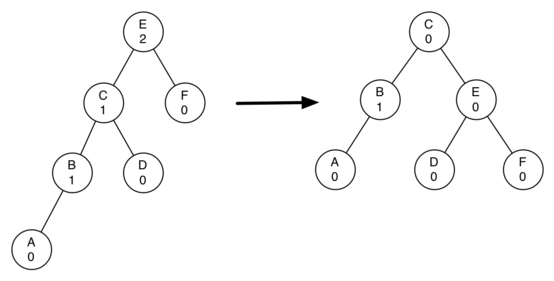
- Preserves “Search Tree” property
- Algorithm?
Right Rotation
L = root.left
root.left = L.right
L.right = root
return L
Makes L the new root of this subtree.
Left Rotation
Similar idea:
R = root.right
root.right = R.left
R.left = root
return R- Makes R the new root of this subtree
- Inverse operations:
- Right rotation followed by left rotation?
Balancing
What does an “unbalanced” tree look like?
Unbalanced Trees
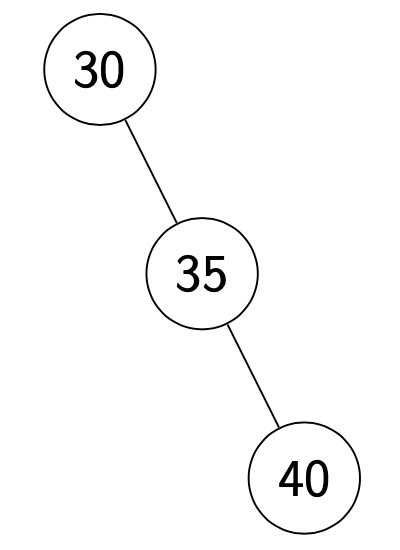
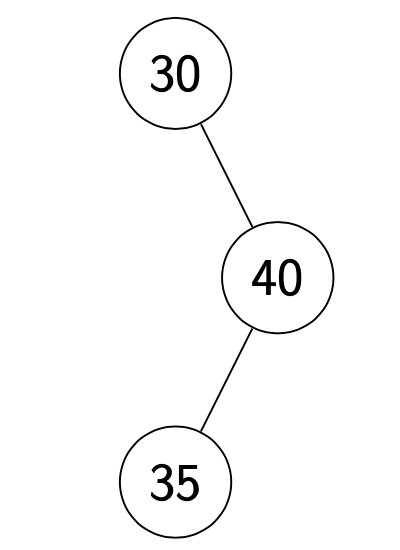
Unbalanced Trees
- Can also define left-right and left-left unbalanced trees
- In general:
- if heights of left and right subtrees differ by more than 1
- Keep track of the height of each node
- If one subtree has a larger height than the other, rebalance
- How do we rebalance? Tree rotations!
Algorithms for balancing
Some unbalanced trees can be rebalanced easily:
- right-right: rotate left
- left-left: rotate right
Right-left
- Rotate left around 30?
- Rotate right around 30? (can’t!)
- Solution?
Self-balancing pseudocode
// psuedocode
private TreeNode<T> insert(T item, TreeNode<T> subtree) {
   // code to insert
   int balance = height(subtree.left) - height(subtree.right);
   if (balance > 1) {
     // left-left or left-right?
   } else if (balance < -1) {
     // right-right or right-left?
   }
}
Exercise
Forget about the code for a bit. What should a self-balancing tree do when we insert in the following order: 1, 2, 3, 4, 5, 6, 7?
Draw the pictures of the BSTs that result. When do we trigger a “rebalancing”?