CS2 Lesson 17
Professor Abdul-Quader
L17 Recursion
Questions
Exam 2 due tomorrow.
Any problems you want me to go over?
Interfaces
- CoinGame:
- Main class has the “game” code.
- Make a “play” method which depends on the
Playerinterface. mainmethod then can determine which implementations are used.- Good general pattern!
- Hint for project 3: plan the interfaces you’ll be using early!
Recursion
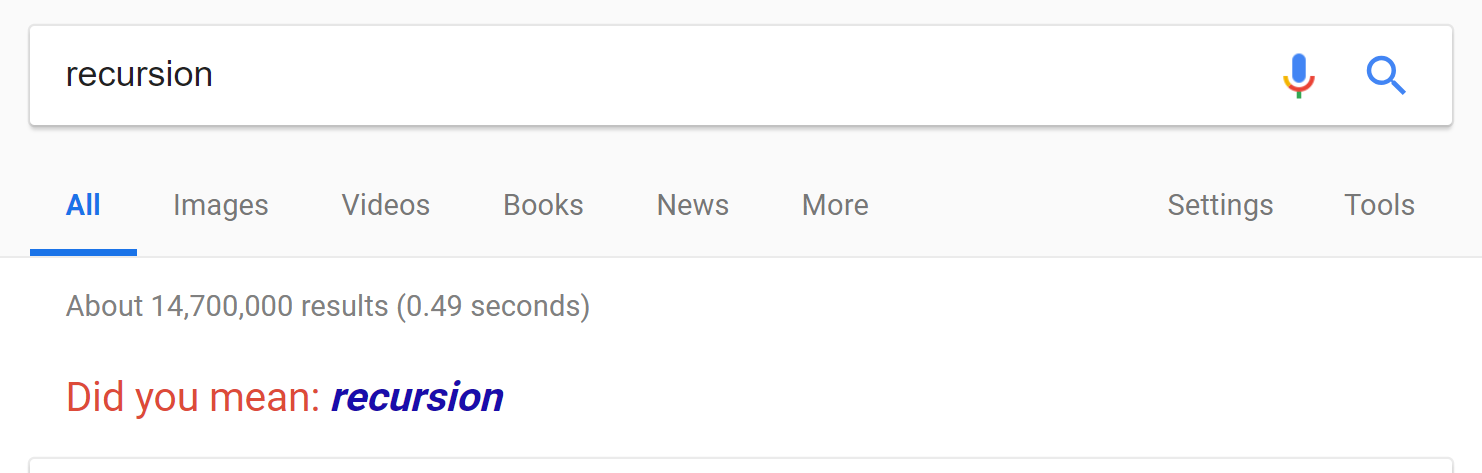
Example
Base Case
A method which invokes itself is called recursive. The add method invokes itself (as long as \(y \neq 0\)).
Recursive methods have a base case: a condition which leads to an actual answer, rather than recursively calling the same method again.
- What is the need for a base case?
- What is the base case in the
addmethod?
Exercise
- Run the RecursionExample program. What is output?
- Change the parameters and see what happens.
- Given any input \(x\) and \(y\), if we invoke
add(x, y), how “deep” does the recursion go?
5 minutes to discuss these at your tables. Nominate one person from your room to share.
Leap of Faith
Project design:
- Break up the problem into smaller components.
- Implement each component on its own (once!), and test each one.
- Re-use the components as needed – trusting that they were implemented correctly the first time!
Recursive Calls
- If we know that a method has been implemented correctly, we don’t need to know how it works, we can just call it and use it.
- Similarly, when we see a recursive call, assume it works! Then we can just use it.
- Important: the assumption is that the recursive call works on smalller inputs.
- Strategy is often to reduce the problem to a smaller problem.
Recursive Factorial
public int recursiveFactorial(int n) {
    if (n <= 0) {
        return 1;
    }

    return n * recursiveFactorial(n - 1);
}- Assume that
recursiveFactorial(n-1)correctly returns \((n-1)!\). - Then \(n \times\)
recursiveFactorial(n-1)is, in fact, equal to \(n!\) (Why?) - Math analogy: proof by induction.
Exercise
Implement a recursive Fibonacci method. Remember:
fib(0)should return \(0\)fib(1)should return \(1\)fib(n)should returnfib(n-1) + fib(n-2)if \(n > 1\).- For the purposes of this method, if \(n < 0\), return \(-1\)
Sum the digits
Problem: Given a (positive) integer, add up its digits.
Recursive idea:
- What is the base case?
- If we know how to solve the problem for a number with fewer digits, how can we use that to solve the problem for a bigger list?
Exercise: Sum Digits
Replit Part 2 space Implement the sumDigits method recursively. Hint: to get the ones digit of a number, use \(num % 10\). To remove the ones digit from the number, use \(num / 10\).
Upcoming
- Exam 2 due tomorrow.
- CoinGame homework due Monday.
- Project 3 will be assigned this weekend, due April 23. (date change)
- Next Thurs: asynchronous (probably).