CS II Lesson 1
Professor Abdul-Quader
L1 Variables / Data Types
Office Hours
- Mondays and Thursdays, 2:45 - 4:15 PM NSB 3003
- Rachel (Learning Assistant) will put her office hours on Moodle as well
Errors Discussion
- Lesson 1 on Replit
- Remove spaces before System.out.println?
- Remove line before public static void main?
- Remove void?
- Change the name of the class?
Variables
- What is a variable?
- What is a data type?
Examples
Variables
Variable: named location in memory.
- Associates 4 bytes of memory with the variable \(x\).
- The type of the variable is
int. - Can do integer type operations with \(x\).
- Difference vs p5?
Primitive Data Types
Primitive type:
- data type that is built in to the language.
- JVM knows exactly how much memory to allocate.
- Examples:
- int: (most common integer type) 32-bit integer
- long: 64-bit integer
- short: 16-bit integer
- byte: 8-bit integer
Other Primitive Types
- float: 32-bit floating point number (decimal)
- double: 64-bit floating point number (most common decimal type)
- boolean: true or false
- char: 16-bit character (‘a’ or “!”)
- String?
- Built-in, but not primitive. Why?
- class, not primitive; we will study classes later
Exercise
What are the values of \(a\) and \(b\) after the following code executes:
Memory Diagrams
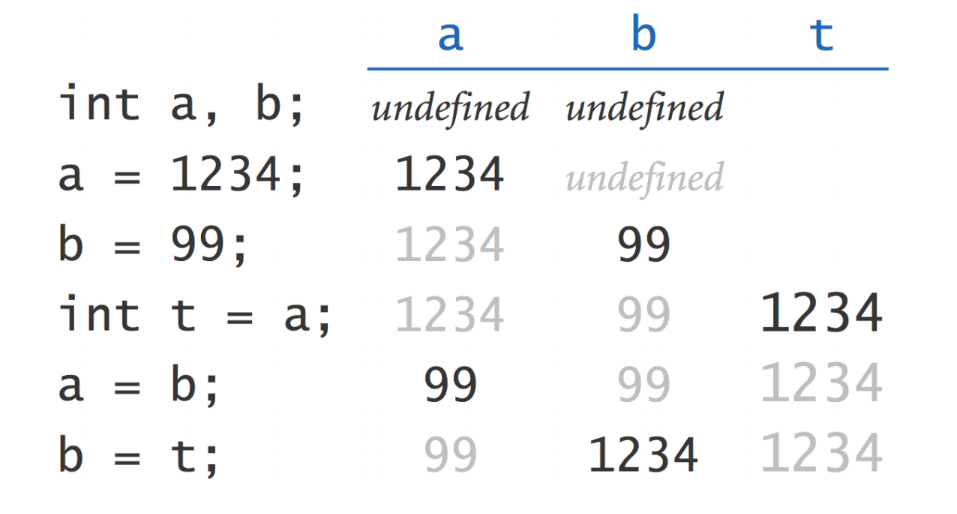
Reading code
- Whenever you read code, make a memory diagram
- Also called “state table”.
- Keep track of current values of variables.
- Particularly important when we get to loops.
- Reading code is an important standard of this course:
- Helps you understand code written by others (say, on your dev team)
- Helps you understand code you wrote yourself, long ago!
Operations
If you read chapter 2: what are some operations that we can do with variables (and/or literals)?
- Assignment
- Arithmetic operations
- Compound operations
- String operations
Assignment
Which of the following are legal / illegal:
Arithmetic operations
Try these out:
int num1 = 5;
int num2 = 10;
System.out.println(num1 + num2);
System.out.println(num1 - num2);
System.out.println(num1 * num2);
System.out.println(num1 / num2);
System.out.println(num1 % num2); // remainder operator
Do any of these output anything different from what you expected?
Arithmetic
- Arithmetic operations are defined on all numeric types.
- Default: Java uses the least amount of memory possible.
- If both sides of an operator are int’s, then the result is stored as an int!
- What will the following do:
Question
How do we make sure Java processes “3 / 2” as a decimal expression?
System.out.println(3.0 / 2);or,System.out.println( (double) 3 / 2);
The second version is called an explicit cast. We tell Java to treat 3 (an integer) as a double.
Expressions / statements
In small groups (two or three, or whatever is convenient at your table). What are all the differences between:
x + 7andy = x + 7;
Based on previous coding knowledge / experience: which of these is a valid statement?
Compound assignment
We often want to assign a variable a value that is based on its current value. For example:
This is so common that many languages (including Java) have compound assignment operators: +=, -=, *=, /= and %=. \(x += y\) means assign the value of \(x + y\) to the variable \(x\).
Example
On paper: make a memory diagram and determine the final values of \(x\) and \(y\).
Increment / Decrement
Values of \(x\) and \(y\) after this? Memory diagram.
Trivia: Difference between \(x++\) and \(++x\)?
Doubles
JVM can automatically convert int to double: no loss of information. Other way around: need an explicit cast:
Warning
double x = 0.7;
double y = 0.9;
double a = x + 0.1;
double b = y - 0.1;
System.out.println(a);
System.out.println(b);
What do we think this will output? What does it output?
Floating point values often have rounding errors. (Why?) Solution? (Avoid doubles and floats if possible)
Exercise
- Write a program that creates variables named day, date, month, and year. Assign values to those variables that represent today’s date.
- Display the value of each variable on a line by itself. Compile and run your program before moving on.
Continued
- Modify the program so that it displays the date in standard American format, for example: Thursday, July 16, 2015.
- Modify the program so it also displays the date in European format. The final output should be:
American format:
Thursday, July 16, 2015
European format:
Thursday 16 July 2015
Submit this on Replit before next class!
Homework
- Submit the replit assignment.
- Try out Chapter 2, Exercise 3. No need to submit. Similar exercise together on Monday.
- Read Chapters 2 (variables / data types) and 3 (getting input).
Coming up
By now, we know how to:
- Store data in variables
- Manipulate that data (arithmetic operations)
- Output that data.
Coming up:
- Getting data from the user (input)
- Comparisons, if-else, and loops
- Arrays: lists of data