Computability Lesson 2: Deterministic Finite State Automata
Warm Up
- Determine the language recognized by the following machine:

- Design a DFA that recognizes the language $\{ w : w $ has an even number of 0s and an odd number of 1s $\}$.
- Design DFAs that recognize the following languages over $\Sigma = \{ a, b \}$:
- $\mathcal{L}_1 = \{ w : $ the number of $a$s in $w$ is a multiple of 3 $\}$.
- $\mathcal{L}_2 = \{ w : $ the number of $b$s in $w$ is odd $\}$.
- $\mathcal{L}_3 = \mathcal{L}_1 \cup \mathcal{L}_2 = \{ w : w \in \mathcal{L}_1$ or $w \in \mathcal{L}_2 \}$.
Recall that the “union” of two sets is defined using “inclusive or”: we are looking for a machine which recognizes all words which are either in $\mathcal{L}_1$ or in $\mathcal{L}_2$ or in both! For a hint on the last one: try to “simulate” going through “both” machines at the same time.
Homework

What is the language of this machine?
DFAs, Formally
To describe a Deterministic Finite Automaton, we need the following:
- states (finitely many)
- an alphabet (finite set of symbols)
- transitions between the states
- a start state
- accepting state(s)
So, formally, a deterministic finite automaton (DFA) is a 5-tuple $(Q, \Sigma, \delta, q_0, F)$ (note: tuples are ordered, so we can refer to the first element of the tuple, second element, etc), where:
- $Q$ is a finite set (called the states),
- $\Sigma$ is a finite, non-empty set (the alphabet),
- $\delta : Q \times \Sigma \to Q$ is a function (the transition function),
- $q_0 \in Q$ (the start state), and
- $F \subseteq Q$ (the set of accept states, or the final states).
Aside: what does $\delta : Q \times \Sigma \to Q$ mean?
- $\delta$ is a function
- $Q \times \Sigma$ is the set of all ordered pairs of the form $(q, a)$, where $q \in Q$ and $a \in \Sigma$,
- the domain of $\delta$ is $Q \times \Sigma$,
- the codomian of $\delta$ is $Q$.
That is: $\delta$ takes in, as input, a state and a symbol, and outputs a state. The meaning of $\delta(q, a) = q^\prime$ is that “if we are at state $q$ and see the symbol $a$ from the input, then we move to state $q^\prime$.”
Questions: From the formal description:
- Must there be a start state?
- Must there be an accept state?
- Can there be more than one start state?
- Can there be more than one accept state?
- Can all states be accept states?
Example
Let’s recall the “Even / Odd” example from last time:
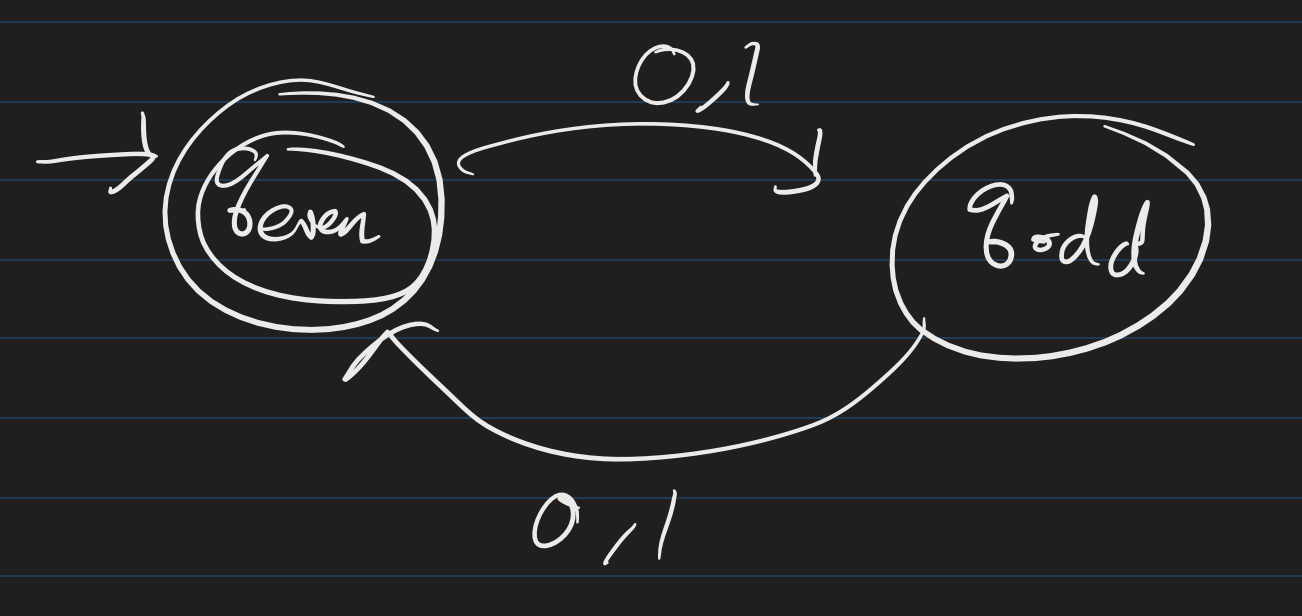
How do we describe this formally?
- There are two states: $q_{\text{even}}$ and $q_{\text{odd}}$.
- The alphabet is $\{ 0, 1 \}$.
- Let’s talk about the transition function, $\delta$, later.
- The start state is $q_{\text{even}}$.
- There is one accept state, $q_{\text{even}}$.
So formally, our machine is $M = \bigl(\{q_{\text{even}}, q_{\text{odd}} \}, \{ 0, 1 \}, \delta, q_{\text{even}}, \{ q_{\text{even}} \}\bigr)$.
How do we describe $\delta$? We could just give the diagram, or we could use the following table:
\[\begin{array}{c | c | c} \delta & 0 & 1 \\ \hline q_{\text{even}} & q_{\text{odd}} & q_{\text{odd}} \\ \hline q_{\text{odd}} & q_{\text{even}} & q_{\text{even}} \end{array}\]Computation
We previously defined “computation” for the “light switch machine” last week. We can define computation in pretty much the same way, using the formal definition of a DFA above. Suppose $M = (Q, \Sigma, \delta, q_0, F)$. We define what it means for $M$ to accept a string $w$:
Let $w = w_1 w_2 \ldots w_n$, where $w_i \in \Sigma$ for each $1 \leq i \leq n$. That is, $w$ is word of length $n$ over $\Sigma$. Then $M$ accepts $w$ if there is a sequence of states $r_0, r_1, \ldots, r_n$ such that:
- $r_0 = q_0$ (the computation begins with the start state),
- $\delta(r_i, w_{i+1}) = r_{i+1}$ for each $0 \leq i < n$, (each successive state in the computation is given by the transition function), and
- $r_n \in F$ (we end in an accept state).
That is, the sequence $r_0, r_1, \ldots, r_n$ is the sequence of states $M$ enters as it reads $w$.
Recall that we say that $M$ recognizes $\mathcal{L}$ if $\mathcal{L} = \{ w : M$ accepts $w \}$.
Definition: $\mathcal{L}$ is a regular language if there is a DFA $M$ such that $M$ recognizes $\mathcal{L}$.
Closure Properties
Previously we saw regular languages $\mathcal{L}_1$ and $\mathcal{L}_2$ such that their union $\mathcal{L}_1 \cup \mathcal{L}_2$ is also regular. How did this work?
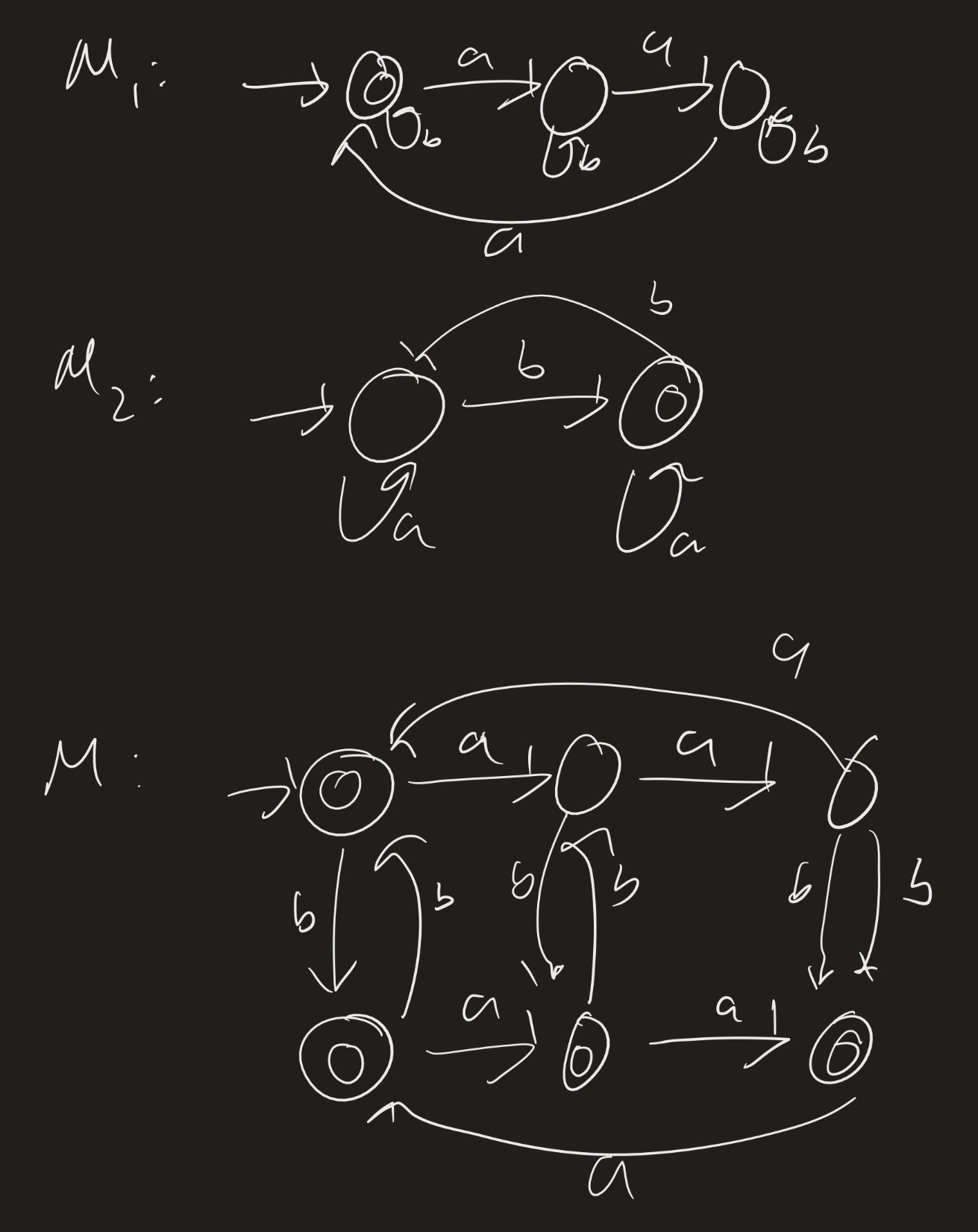
It almost looks like we took 2 copies of $M_1$ and put them on top of each other; alternatively, you could think of it as putting three copies of $M_2$ next to each other.
We will show today that if $\mathcal{L}_1$ and $\mathcal{L}_2$ are both regular languages, then so is $\mathcal{L}_1 \cup \mathcal{L}_2$. That is, if we have two DFAs $M_1$ and $M_2$, we can construct a third DFA $M$ which accepts a word $w$ if and only if $M_1$ accepts $w$ or $M_2$ accepts $w$.
Example
Let’s do another warmup example.
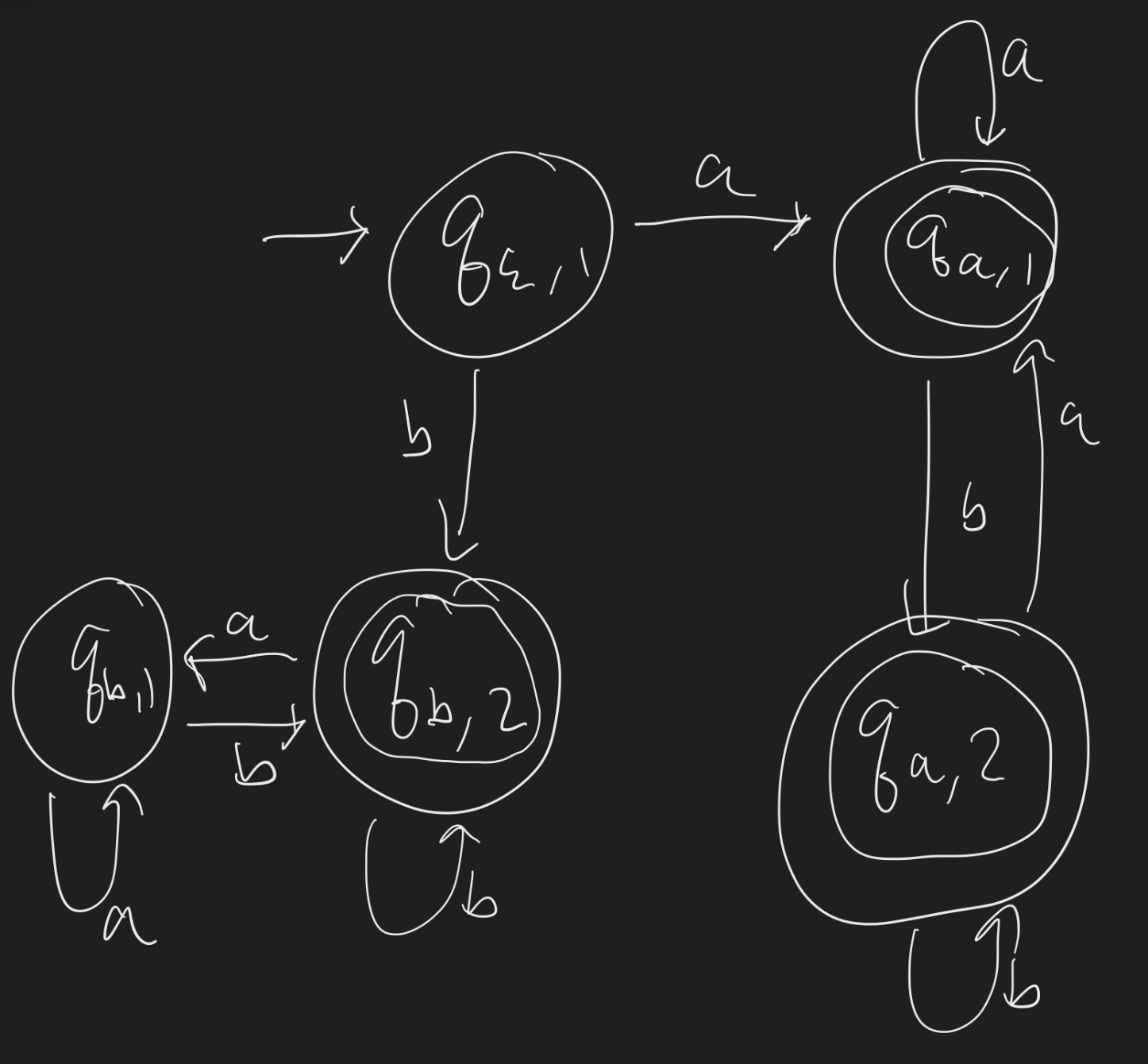
- Design a DFA which accepts $\mathcal{L}_1 = \{ w : w$ starts with $a \}$.
- Design a DFA which accepts $\mathcal{L}_2 = \{ w : w$ ends with $b \}$.
- Design a DFA which accepts $\mathcal{L}_1 \cup \mathcal{L}_2$. (What words do we need to accept here? What words do we reject here?)
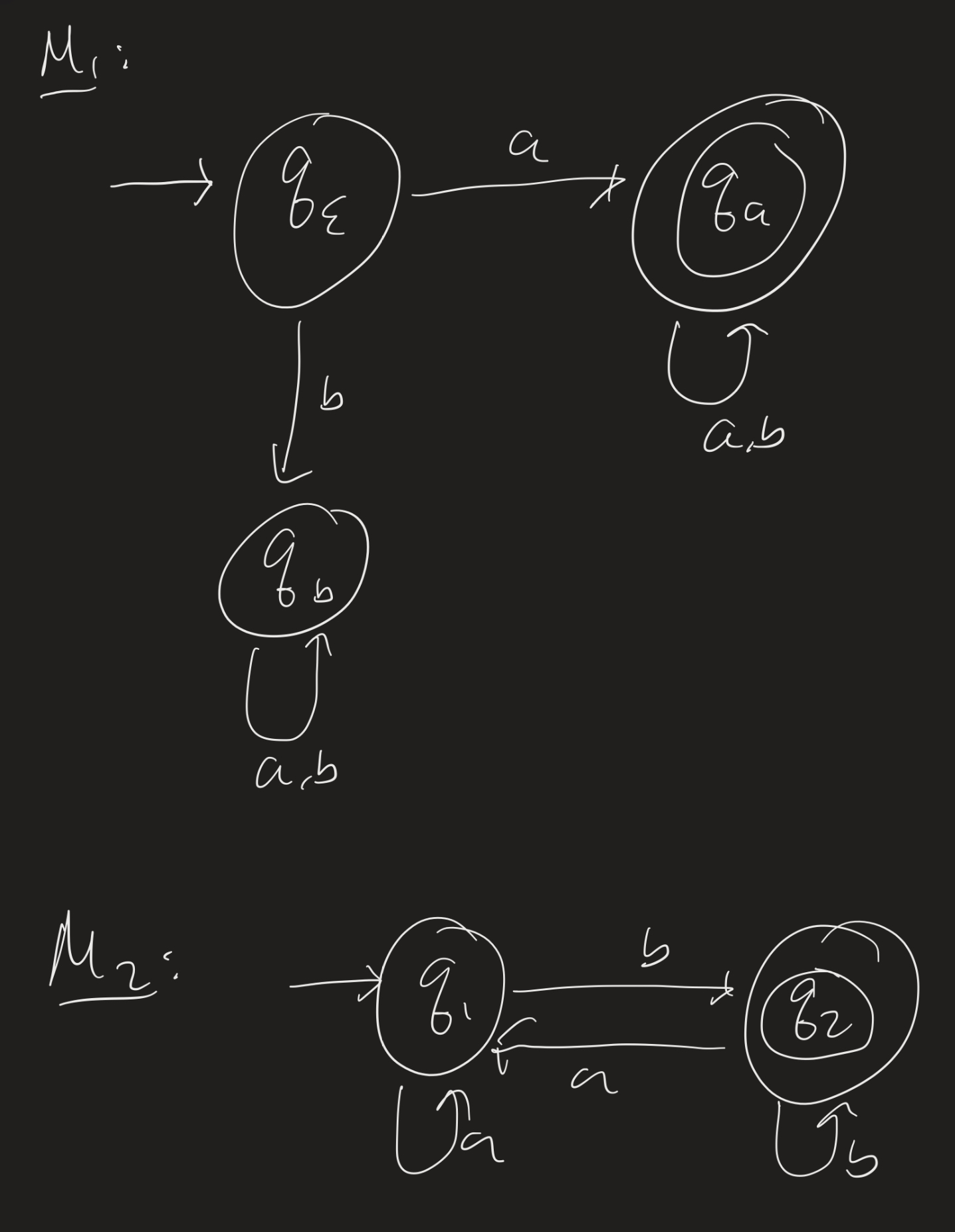
So how do we design the third one? Again, try to design a machine which “runs” both machines at once. That is, if we see any symbol while we’re in the start state, we move to a state that keeps track of where machine $M_1$ is in (after reading that symbol) and where machine $M_2$ is in.
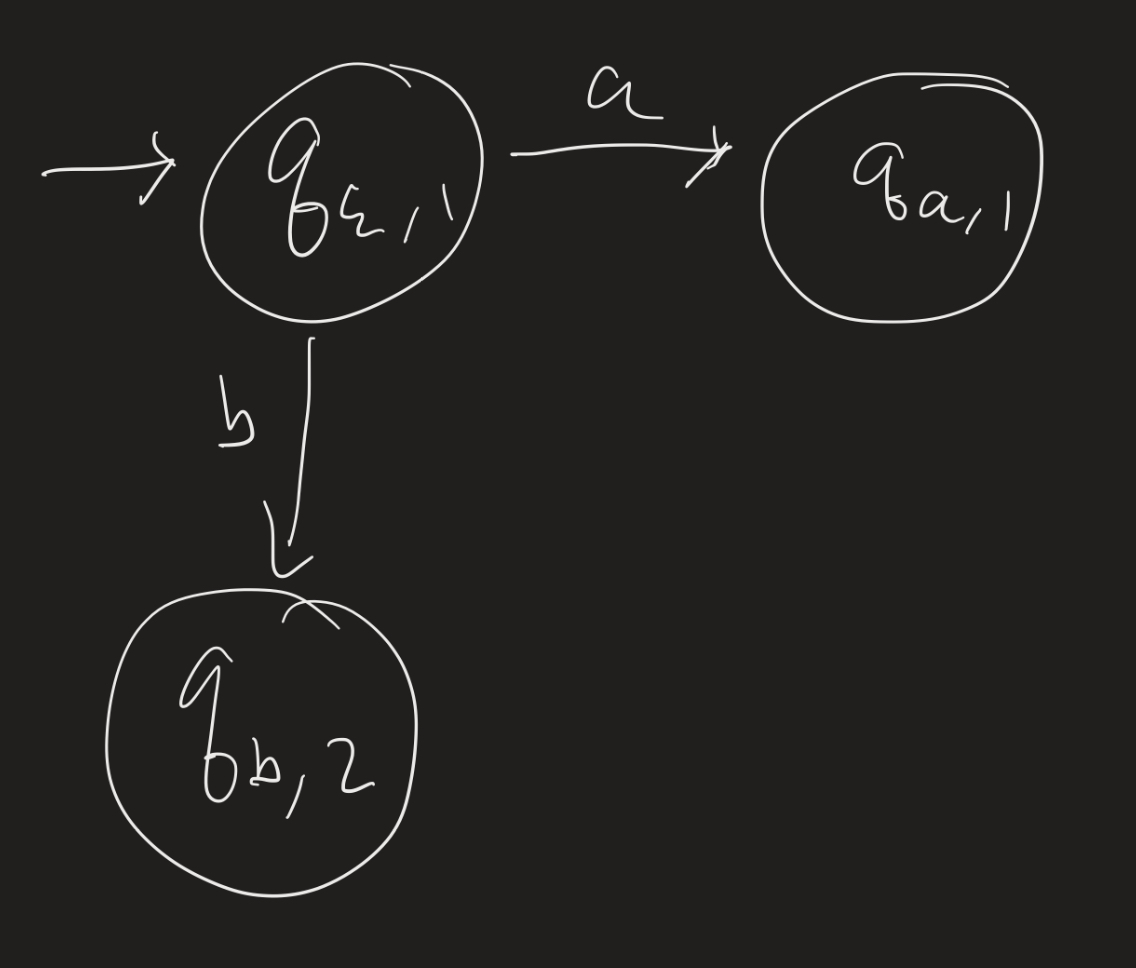
Then keep going!
Union
So the idea, again: keep track of both states at the same time. How do we do this? If $q$ is a state in $M_1$, and $q^\prime$ is a state in $M_2$, then make $(q, q^\prime)$ a corresponding state in our new machine $M$! Then we can use the transition functions from $M_1$ and $M_2$ to figure out the transition function for $M$.
Theorem: The class of regular languages is closed under unions.
What does this mean? If $\mathcal{L}_1$ and $\mathcal{L}_2$ are regular languages, so is $\mathcal{L}_1 \cup \mathcal{L}_2$.
This does not mean that if $\mathcal{L}_1$ is not regular and $\mathcal{L}_2$ is not regular, then $\mathcal{L}_1 \cup \mathcal{L}_2$ is not regular. That statement is false!
Proof: Suppose $M_1 = (Q_1, \Sigma, \delta_1, q_1, F_1)$ and $M_2 = (Q_2, \Sigma, \delta_2, q_2, F_2)$ recognize $\mathcal{L}_1$ and $\mathcal{L}_2$, respectively. We construct $M = (Q, \Sigma, \delta, q_0, F)$ as follows:
- Let $Q = Q_1 \times Q_2$. (One state for each pair $(q, q^\prime)$, where $q \in Q_1$ and $q^\prime \in Q_2$)
- $\Sigma$ is the same alphabet for all three machines.
- The start state $q_0 = (q_1,q_2)$: the start state of $Q_1$ along with the start state of $Q_2$.
- The accept states $F$ are all states of the form $(q, q^\prime)$ where either $q \in F_1$ or $q^\prime \in F_2$.
How do we define $\delta$? If $(q, q^\prime) \in Q_1 \times Q_2$ and $s \in \Sigma$, what is $\delta((q, q^\prime), s)$?
- Since $q \in Q_1$, we can check $\delta_1(q, s)$.
- Since $q^\prime \in Q_2$, we can check $\delta_2(q^\prime, s)$.
So we define $\delta((q, q^\prime), s)$ as $(\delta_1(q, s), \delta_2(q^\prime, s))$.
Now we have described our machine. We must show that this machine recognizes $\mathcal{L}_1 \cup \mathcal{L}_2$. That is, we have to show:
- If $w \in \mathcal{L}(M)$, then either $w \in \mathcal{L}_1$ or $w \in \mathcal{L}_2$, and,
- If $w \in \mathcal{L}_1$ or $w \in \mathcal{L}_2$, then $w \in \mathcal{L}(M)$.
Let $w = w_1 \ldots w_n$. Suppose $r_0, \ldots, r_n$ is the sequence of states that $M_1$ enters during its computation on $w$, and $s_0, \ldots, s_n$ is the sequence of states that $M_2$ enters during its computation on $w$.
That is, $\delta_1(r_i, w_{i+1}) = r_{i+1}$ and $\delta_2(s_i, w_{i+1}) = s_{i+1}$ (by definition of computation, given earlier today). This means that $\delta( (r_i, s_i), w_{i+1}) = (r_{i+1}, s_{i+1})$, as that is how we defined $\delta$ for $M$.
Suppose $M$ accepts $w$. That means $(r_n, s_n) \in F$. By definition of $F$, then, that means either $r_n \in F_1$ or $s_n \in F_2$. That is, either $M_1$ accepts $w$ or $M_2$ accepts $w$.
Now suppose $M_1$ accepts $w$. Then $r_n \in F_1$, so $(r_n, s_n) \in F$, and so $M$ accepts $w$. Similarly, if $M_2$ accepts $w$, then $s_n \in F_2$, so $(r_n, s_n) \in F$.
Exercise: Show that the class of regular languages is closed under intersection.
Problem Set 1
Due Thursday, February 8:
For all of these problems, the alphabet $\Sigma = \{ 0, 1 \}$.
- Let $\mathcal{L}_1 = \{ w : w$ starts with a 0 and has odd length $\}$.
- Give a state diagram of a DFA that accepts $\mathcal{L}_1$.
- Give the formal description of the DFA as well.
- Consider the language $\mathcal{L}_2 = \{ (01)^n : n \in \mathbb{N} \}$.
- Give two examples of words in $\mathcal{L}_2$ and two examples of words not in $\mathcal{L}_2$.
- Give a state diagram of a DFA which accepts $\mathcal{L}_2$.
- Show that if $\mathcal{L}_1$ and $\mathcal{L}_2$ are regular languages, then so is $\mathcal{L}_1 \cap \mathcal{L}_2$. That is: prove that the class of regular languages is closed under intersection.
- (We haven’t learned this yet) Let $\mathcal{L}_3 = \{ xy : x$ and $y$ are words over $\Sigma$, $x$ starts with a $0$, and $y$ starts with a $1 \}.$ Show that $\mathcal{L}_3$ is regular by giving a state diagram of an NFA which recognizes it.
- Convert your NFA in question (4) to a DFA using the algorithm described in class.