Computability Lesson 11: Turing Machines
Warm up
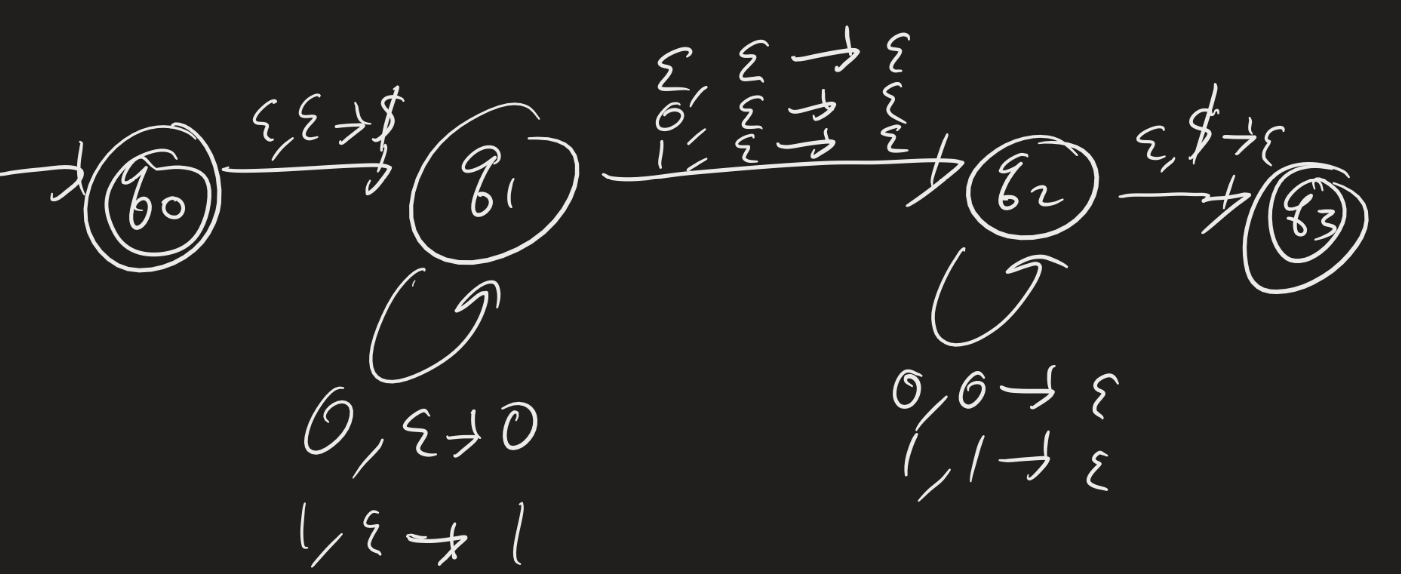
- Determine the language accepted by this machine:
- Design a PDA which recognizes $\mathcal{L} = \{ a^n b^m : n \leq m \}$.
Another Example
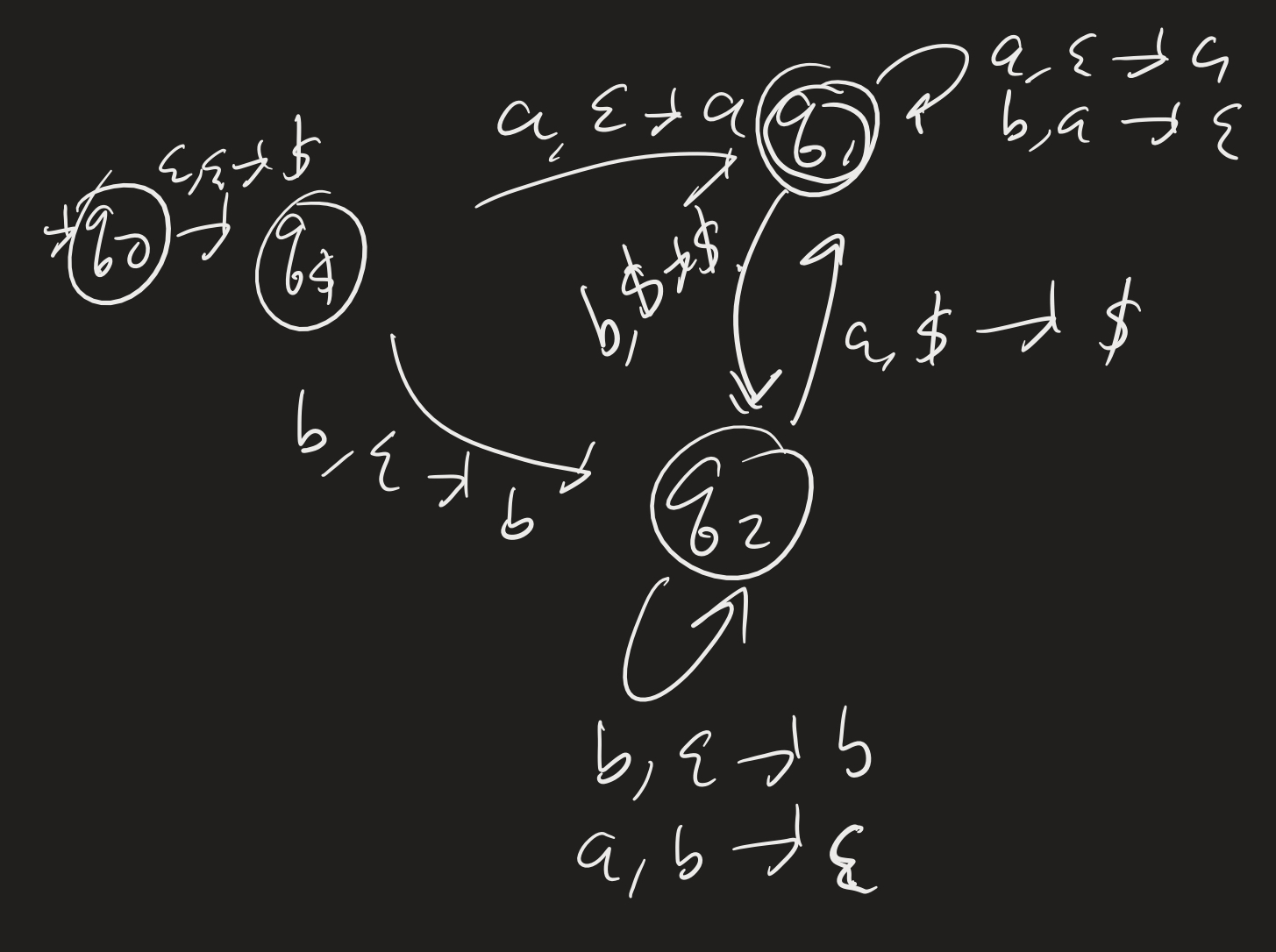
Design a PDA which recognizes $\mathcal{L} = \{ w : w$ has at least as many $a$s as $b$s $\}$.
Idea: After the start state, push the “start marker”. Then keep track of two states: one where you have at least as many a’s, and one where you have more b’s.
How would we use the stack to figure out when to transition between these?
- In the “more bs” state:
- If you see a $b$, add it to the stack.
- If you see an $a$ and you can pop a $b$, pop it.
- If you see an $a$ and you can pop the start symbol, pop that, and go to the “more a’s” state.
- In the “more a’s” state?
Formalizing?
How would we need to change the formal definition of an NFA to get a PDA? What, specifically, do we need to change, and how would they change?
Pushdown Automata Questions?
Turing Machines
Recall the notion that Turing described in his paper, and we talked about in our first class. If we were “computing” an arithmetic problem on paper, we would keep track of different “states of mind” (for example, which “digit” we are looking at in a sum), we would follow specific rules based on what “inputs” we see, and we could use some amount of “scratch work”. These correspond to the three ideas mentioned a few times at this point: state, transitions, and memory.
Informally, a Turing Machine is a DFA with an infinite read/write tape. We make a small modification so that it has a single accept state and a single reject state. If computation ever reaches an accept or reject state, it immediately stops. Of course, we might never reach an accept / reject state – it is possible that computation proceeds forever (just like in regular programming: you might hit an infinite loop!).
We will see that this is a much more powerful notion of computation. For example, the following languages (none of which are regular, one of which is also not context-free), are all “computable”:
- $\mathcal{L}_{+} = \{ a^n + a^m = a^{n+m} : n, m \in \mathbb{N} \}$ (over $\Sigma = \{ a, + \}$).
- $\mathcal{L}_{\times} = \{ a^n \times a^m = a^{nm} : n, m \in \mathbb{N} \}$ (over $\Sigma = \{ a, \times \}$).
- $\mathcal{L}_{<} = \{ a^n < a^m : n, m \in \mathbb{N}, n < m \}$ (over $\Sigma = \{ a, < \}$).
(Question: can you figure out which of these are context-free? Hint: try to compute these using a stack.)
Computation on a TM starts with the input $w$ written on the tape $w = w_1 w_2 \ldots w_n$. We start at $q_0$, the start state, and the “read head” of the tape is pointing to $w_1$. We envision the tape as being infinite in “one way”, so that you can’t go left from the beginning (so $w_1$ is at the beginning, and you cannot move left from there). $\delta$ will tell us what to do if we read the symbol $a$ from the tape at state $q$:
- write $b$?
- move R or L on the tape?
- transition to state $q^\prime$?
Again, this is determnistic, so if we are at state $q$ and we see the symbol $a$ on the tape, we need to decide exactly what those three things will be. We would write $\delta(q, a) = (q^\prime, b, R)$ to mean “At state $q$, if we see $a$, transition to state $q^\prime$, write a $b$ on the tape, and then move the read head of the tape one step right.”
Warm-up
Consider the language $\mathcal{L} = \{ 0^{2^n} : n \in \mathbb{N} \}$. We saw that this is not regular. In fact it is also not context free (not going to prove this).
We want a TM which recognizes $\mathcal{L}$. We start our computation with a string of 0s on the tape:

We want to check if it has $2^n$ 0s on it, for some $n$. How would we do that?
Aside: How would you check this in a programming language? Something along the lines of:
public boolean powerOfTwo(int n) {
  if (n <= 0) {
    return false;
  }
  while (n > 1) {
    if (n % 2 == 1) {
      return false;
    }
    n = n / 2;
  }
  return true;
}
In other words: if $n$ is 0, reject. If $n$ is 1, accept. Otherwise, check if we can divide it by 2. If we get an odd remainder, reject. If not, divide it by 2 and repeat. If we ever get to exactly one zero on the tape, accept.
How would we implement this with a TM? (DFA + tape?)
- If there are no zeros, reject. (This can be done: if we see a blank at the beginning, reject.)
- Check if there is exactly one zero. (This can be done: if we see a zero, that’s one. If we see a blank after that, we accept.)
- “Cross off” every other zero, by replacing the 0 with some other symbol on the tape (maybe an “x”).
- If there are any zeros left over at the end, reject.
- If not, go back to the beginning of the tape and repeat. (enter a state which just moves left until the beginning of the tape.)
To do this, we will need to keep track of both “ends” of the tape. One way to do so is to overwrite the first 0 with a “blank” symbol, and then using the “blank” symbols, we can see if we are at the end of the tape.
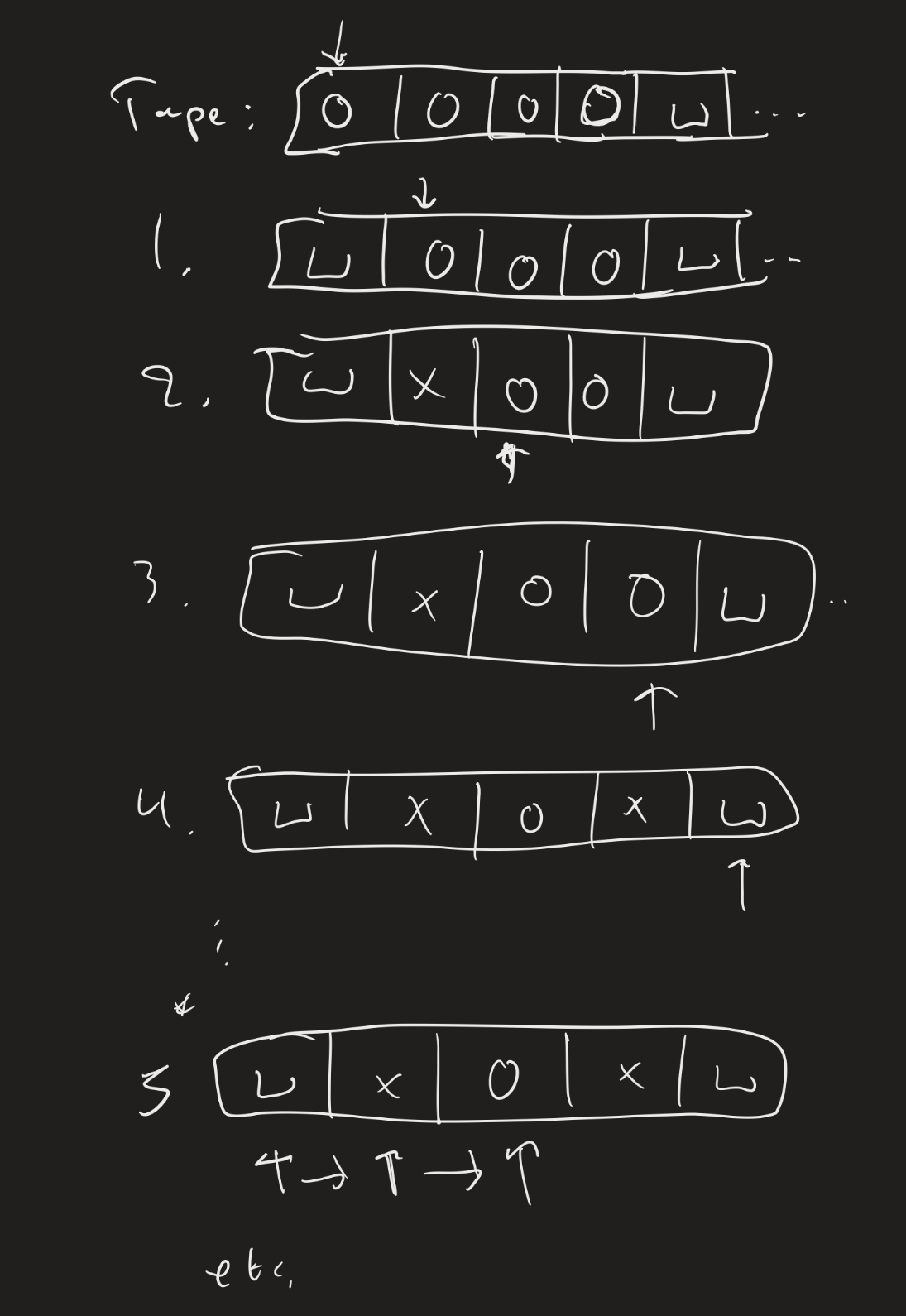
So what would the state diagram of this TM look like? We could start with, at the start state, checking to see if there’s a blank or a 0. Keep in mind, that firs t0 will need to be replaced with a blank so that we can keep track of the beginning:
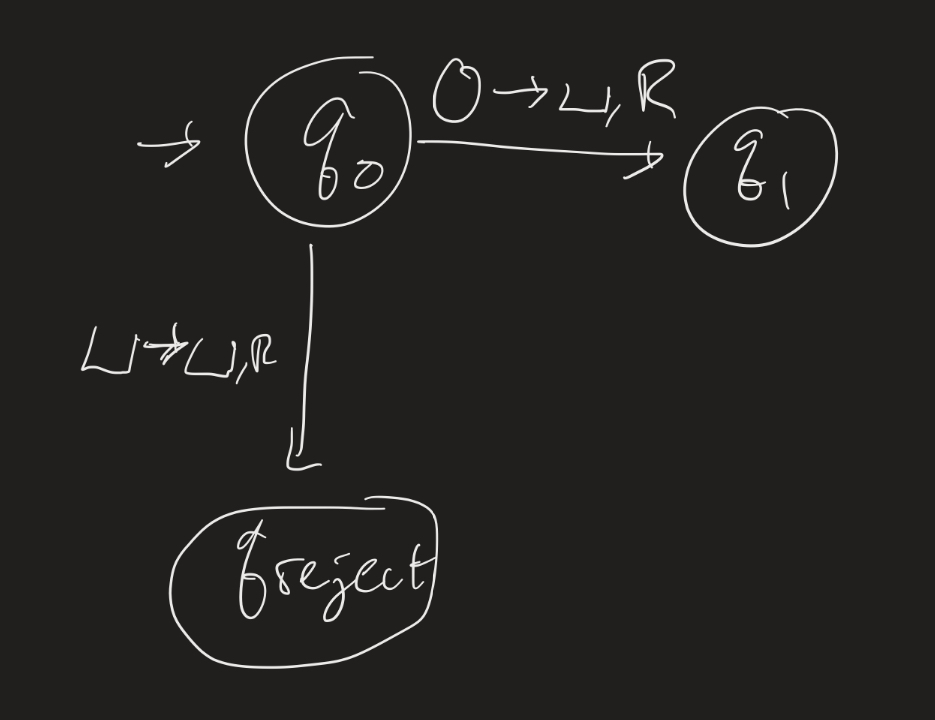
At $q_1$, we’ve seen exactly one zero. If we don’t see any more, accept! If we see another one, we can “cross that off”, and move to another state.
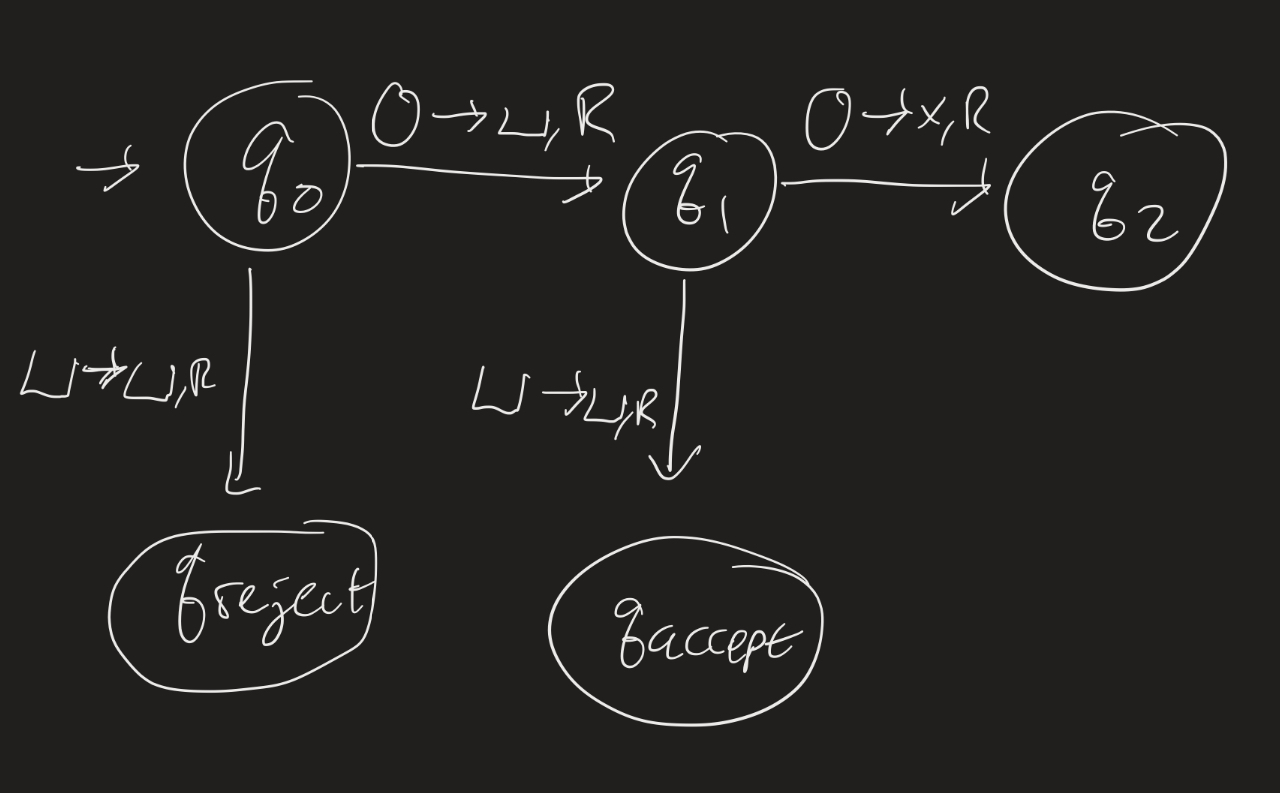
Now at $q_2$, we have seen two zeros by this point (so we are at an even number), and we’ve crossed off one. Let’s set up a loop which will check for even/odd number of zeros, and cross off half of them:
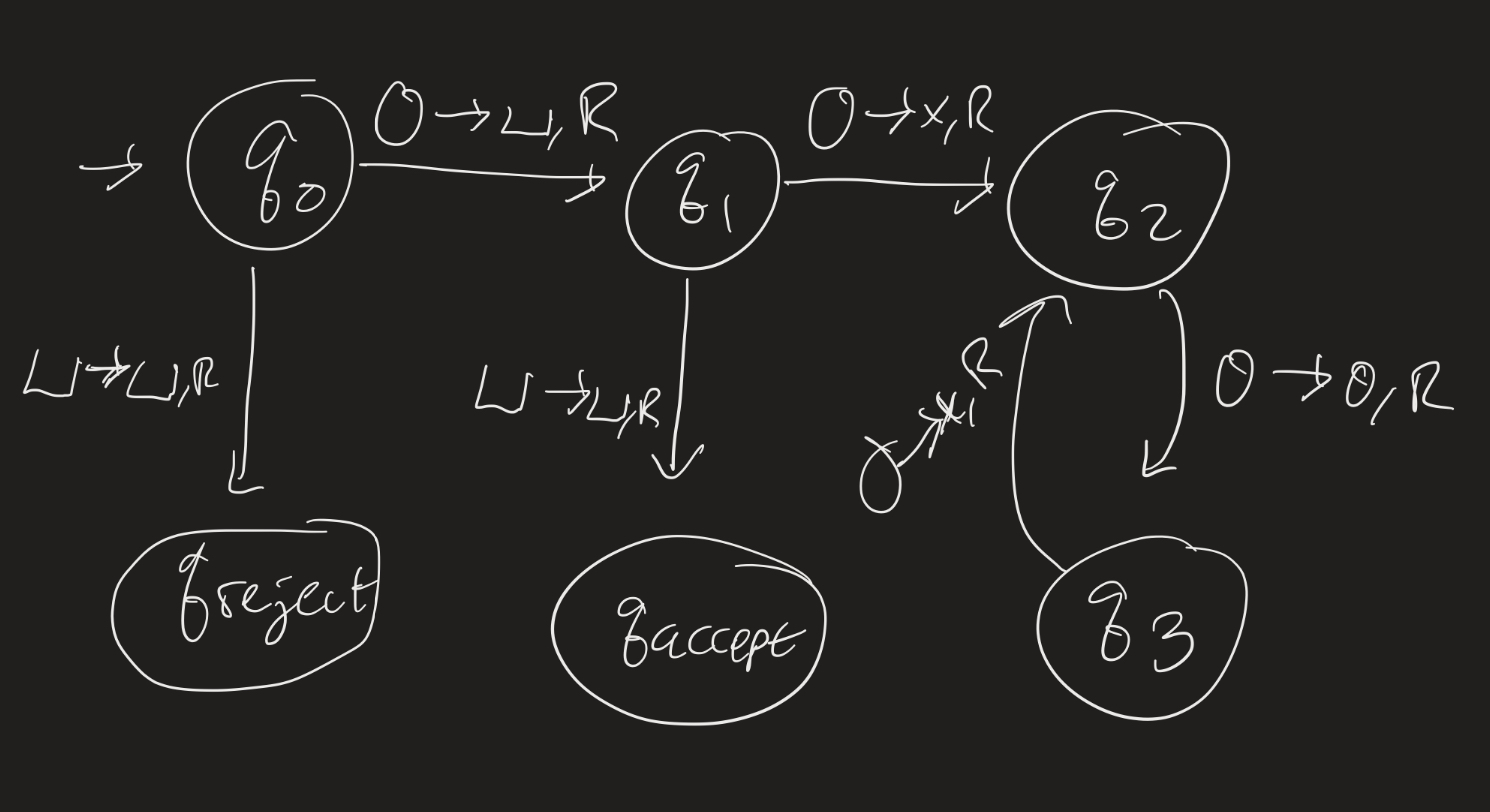
At $q_3$, we would see an “odd” number of zeros. If we see a blank at the end, that means that there was an odd number, and so we reject.
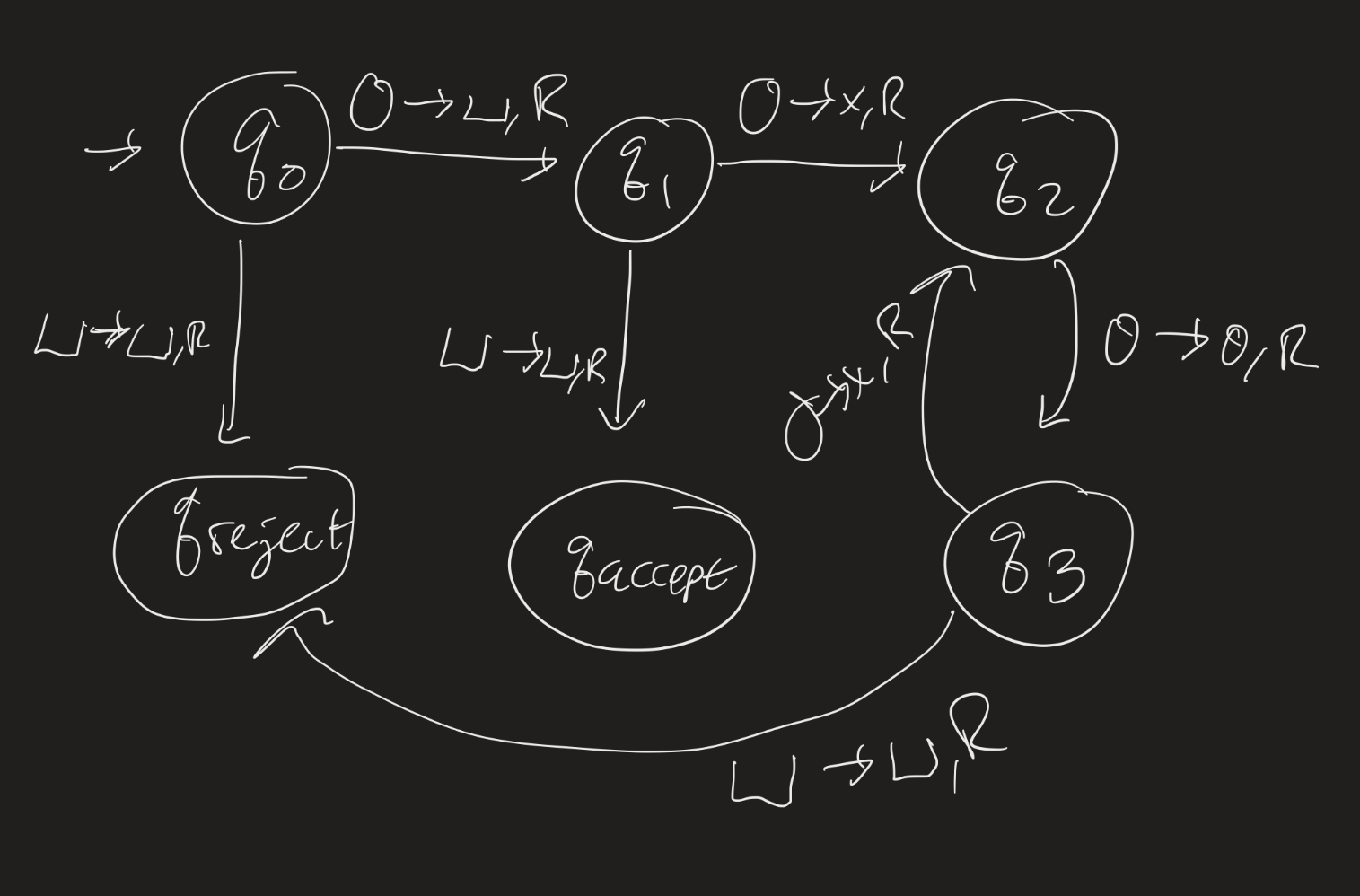
Now we’re almost done. We just need to fill in a few more details:
- What happens if we see a blank at $q_2$? Then we have reached the end of the tape with an even number of zeros, having crossed out half of them. We try to go back to the beginning, and repeat.
- What if we see $x$’s on the tape at any of the states we have seen? In most cases, we should just skip them, as they represent “crossed out zeros”.
So finally we get this machine:
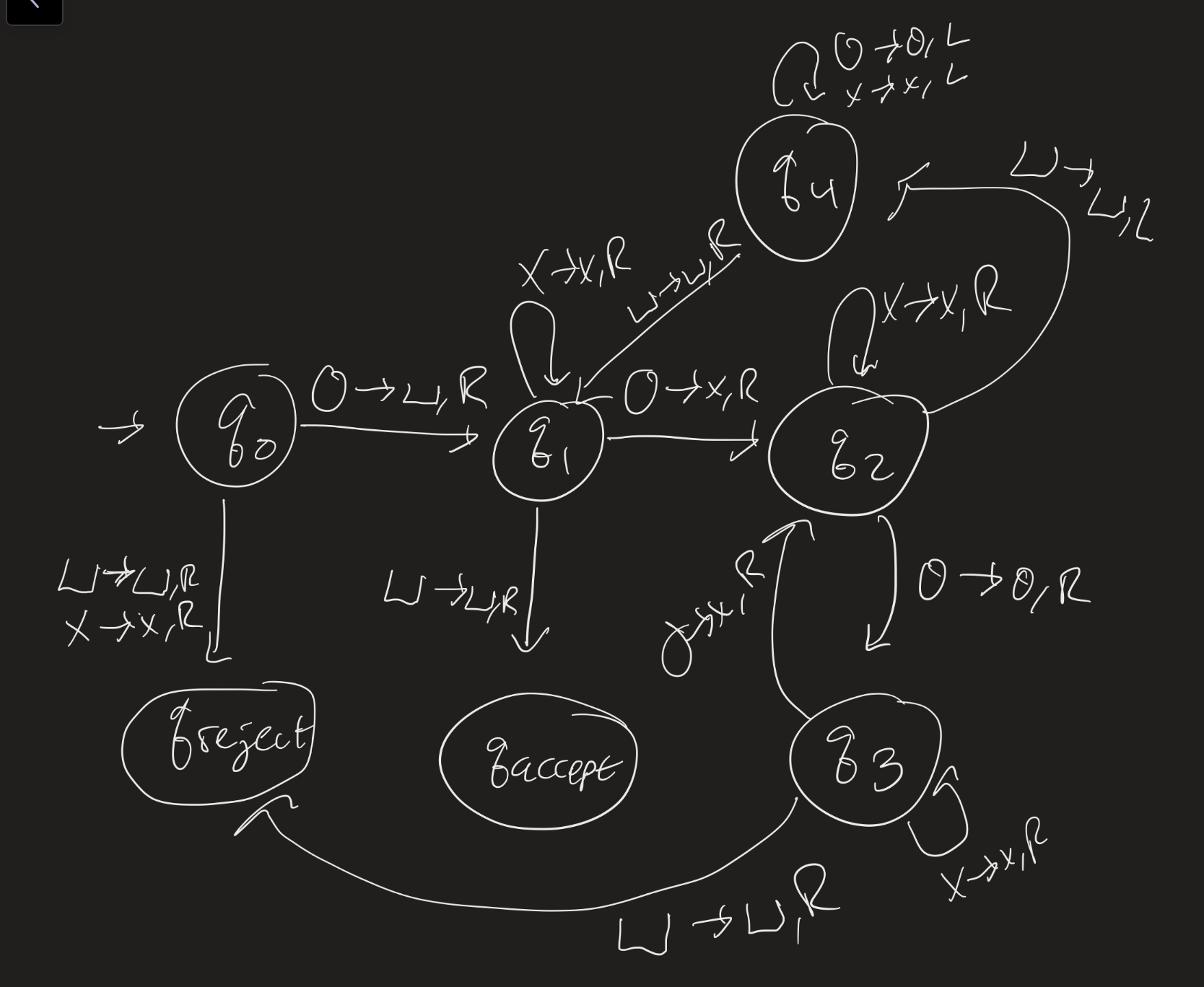
So the upshot is: using the tape, we are able to count!
Example
Consider the language $\mathcal{L}_< = \{ a^n < a^m : n < m \}$. How might we use the tape to determine if a string is of this form?
The idea would be to “zig-zag” around the inequality symbol:
- Keep track of the “left” side with a blank.
- Go past the “<” symbol, and write an “x” over the first “a”.
- Go back, write an “x” over the first “a” on the left, and go forward and write an “x” over the first “a” after “<”.
- Keep doing this. If we ever run out of “a”s on the right, reject!
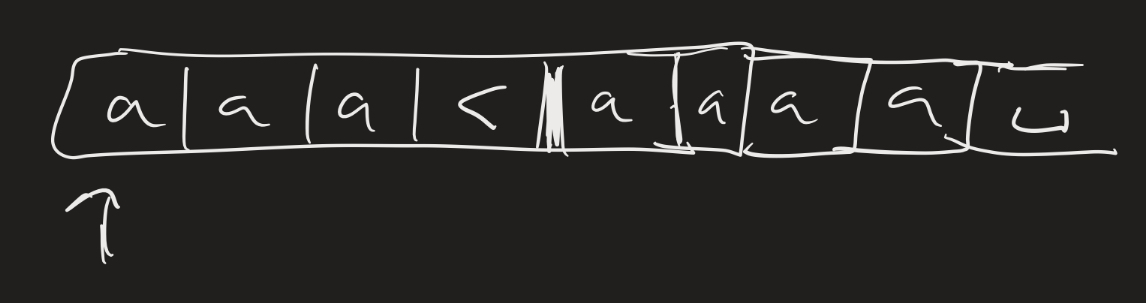
Then:
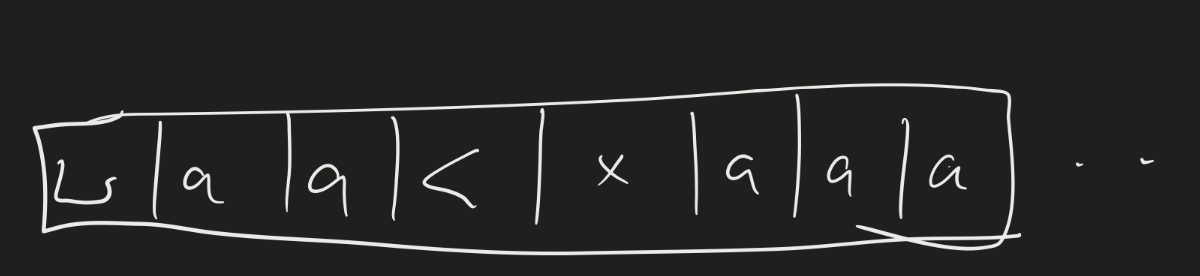
So again, step one might look like this:
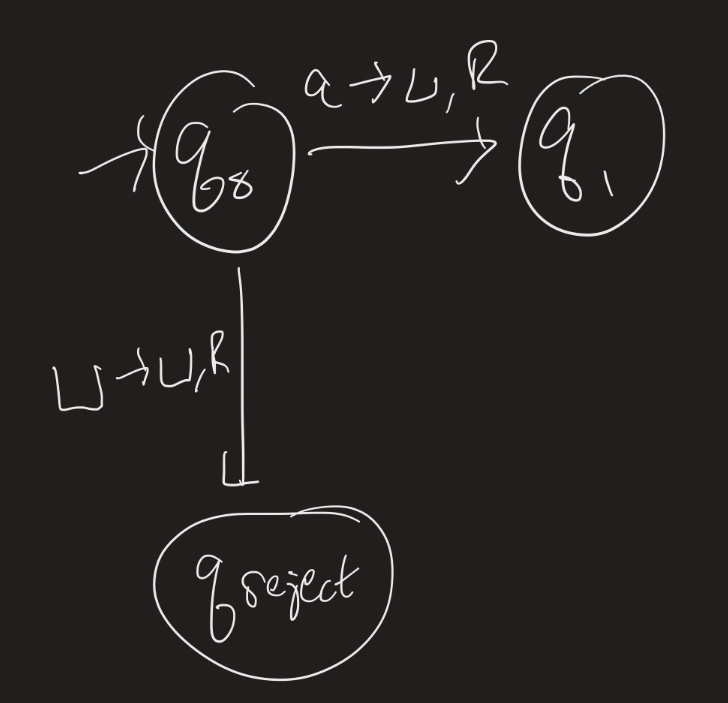
At $q_1$, skip over everything until we see the “<”. Then go to $q_2$, where you skip to the first “a” and replace it with an “x”.
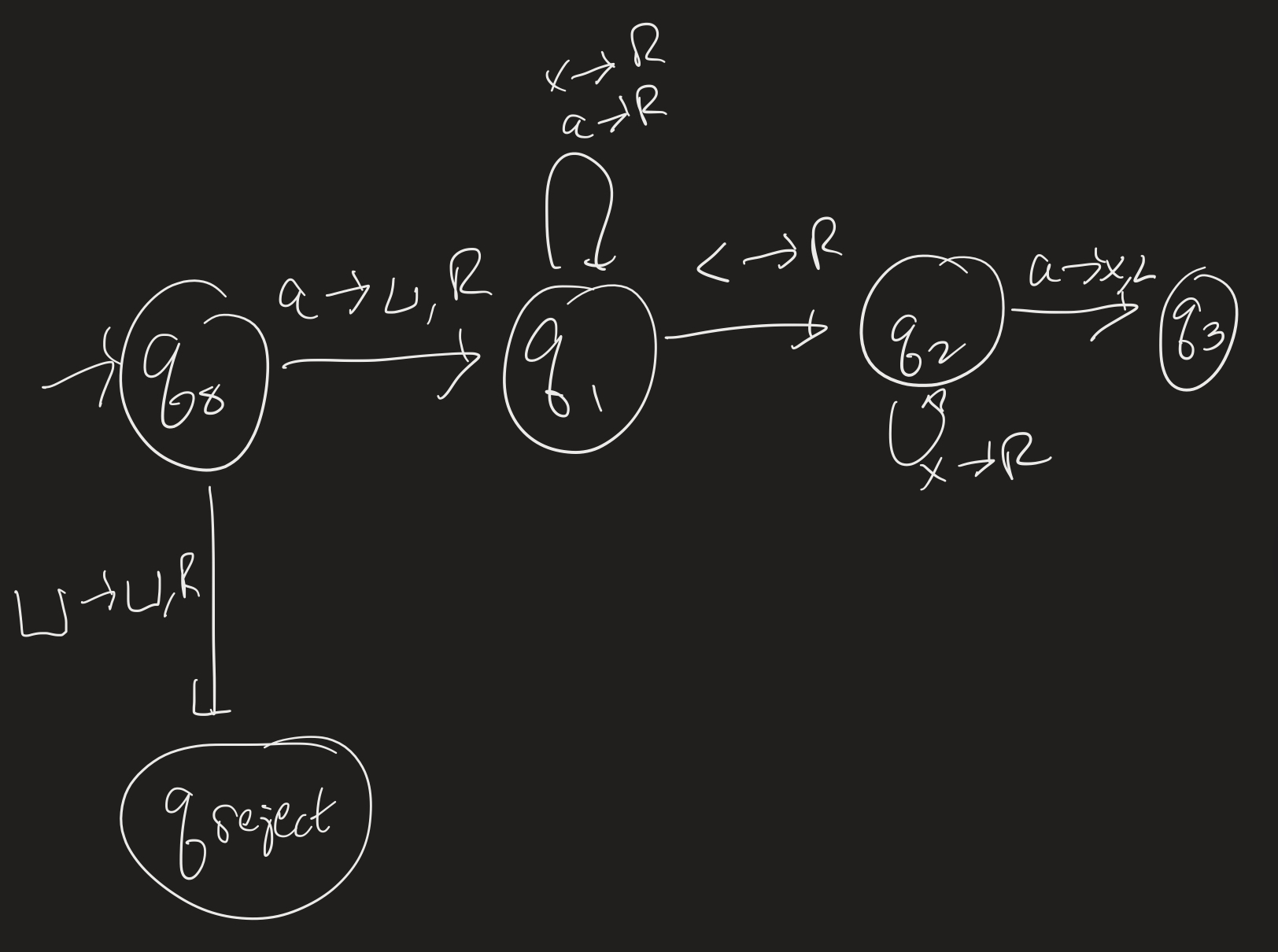
Now skip over all the x’s, searching back until you see the “<”. Transition to $q_4$.
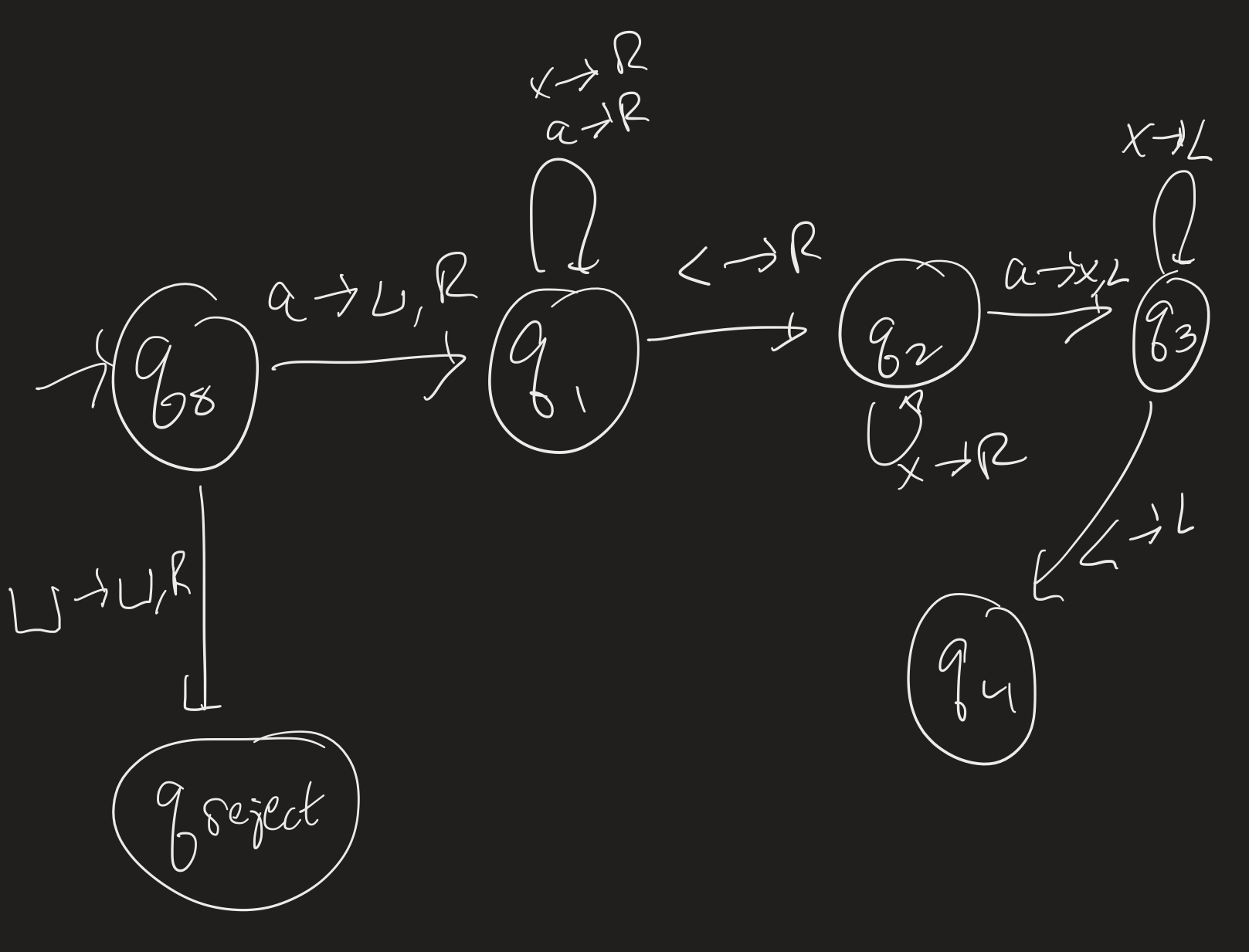
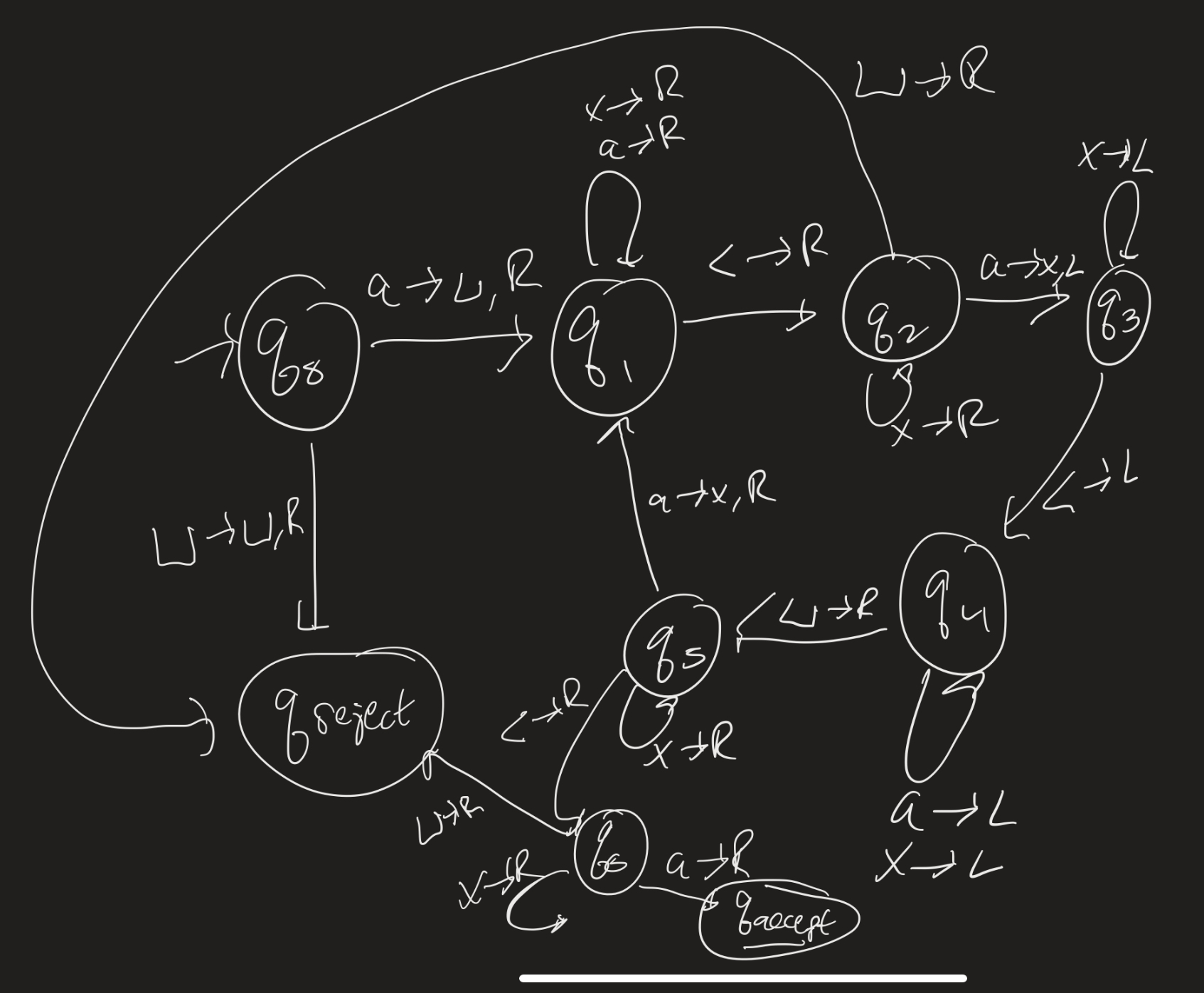
At this point, I’ll skip to the end, but we have a few more things to do:
- We are currently at a state which needs to “scroll back” to the beginning. Do that.
- We will enter a new state ($q_5$). At $q_5$, we search for an “a” to cross off.
- If we never see an “a”, then that means we’ve crossed off everything on the left. Enter a new state ($q_6$) which looks for an “a” on the right, and then accepts if it finds one (rejects if it doesn’t!)
- If we do see an “a”, cross it off, and return to $q_1$, which was our original “crossed off one a on the left” state.
Question: At a “high level”, how might we be able to use the tape to decide if a string is of the form $a^n + a^m = a^{n + m}$? Or of the form $a^{n} \times a^{m} = a^{nm}$?
Formal Description
A Turing Machine is a 7-tuple $(Q, \Sigma, \Gamma, \delta, q_0, q_{\text{accept}}, q_{\text{reject}})$, where:
- $Q$ is a finite set (the states),
- $\Sigma$ is a finite, non-empty set not containing the “␣” symbol (the input alphabet). (In latex, use
\textvisiblespaceor$\sqcup$), - $\Gamma$ is a finite set (the tape alphabet), where $\sqcup \in \Gamma$ and $\Sigma \subseteq \Gamma$,
- $\delta : Q \times \Gamma \to Q \times \Gamma \times \{ L, R \}$ is the transition function,
- $q_0 \in Q$ is the start state,
- $q_{\text{accept}} \in Q$ is the accept state, and
- $q_{\text{reject}} \in Q$ is the reject state, and $q_{\text{accept}} \neq q_{\text{reject}}$.
A configuration of a TM is a description of the following:
- the current contents of the tape,
- the location of the read-write head,
- the current state the TM is in.
There are many ways to do this. The book uses the convention $uqv$, where $u$ and $v$ are strings over $\Gamma$, $q$ is the state the TM is in, the string $uv$ is written on the tape, and the read head is pointing the first symbol of $v$. I prefer the following notation:
Notation: A configuration of a TM is given by the triple $(w, i, q)$, where $w \in \Gamma^*$ is the string on the tape (starting from the “left-edge” of the tape, which may contain blanks, all the way until the rightmost non-blank symbol), $i \in \mathbb{N}$ is the position of the read-head on the tape, and $q \in Q$ is the state the TM is currently in.
Say a configuration $(w, i, q)$ yields a configuration $(w^\prime, j, q^\prime)$ if the following are true:
- $w_k = w^\prime_k$ for each $k \neq i$, and
- One of the following is true:
- $\delta(q, w_i) = (q^\prime, w_i^\prime, R)$, and $j = i + 1$,
- $i > 0$, $\delta(q, w_i) = (q^\prime, w_i^\prime, L)$ and $j = i - 1$ or,
- $i = j = 0$, and $\delta(q, w_i) = (q^\prime, w_i^\prime, L)$. (You cannot go “left” from position 0 on the tape)
Technicality: if $i > |w|$, we allow for $w_i$ to be the blank symbol ␣.
Now we can define computations.
Definition: Let $M = (Q, \Sigma, \Gamma, \delta, q_0, q_{\text{accept}}, q_{\text{reject}})$ be a TM.
- On input $w \in \Sigma^*$, the start configuration is $(w, 0, q_0)$. (The word $w$ is on the tape, the “read head” is at position 0, and we are in the start state).
- An accepting configuraiton is any configuration $(u, i, q_{\text{accept}})$ (no matter what $u \in \Gamma^*$ and $i \in \mathbb{N}$ are). Similarly, a rejecting configuration is any configuration $(u, i, q_{\text{reject}})$.
- A halting configuration is either an accepting or rejecting configuration.
$M$ accepts $w$ if there is a sequence of configurations $C_1, \ldots, C_k$, for some $k \in \mathbb{N}$ such that:
- $C_1$ is the start configuration.
- $C_k$ is the accepting configuration, and,
- For each $i < k$, $C_i$ yields $C_{i+1}$.
Definition:
- $\mathcal{L}(M) = \{ w \in \Sigma^*$ : M$ accepts $w \}$ is the language recognized by $M$.
- If $\mathcal{L}$ is a language and there is $M$ such that $\mathcal{L}(M) = \mathcal{L}$, we call $\mathcal{L}$ computably enumerable (c.e.). Historically, the term “recursively enumerable” (or r.e) was also used. The textbook uses the term “Turing recognizable”. These all mean the same thing, but I will use the term used by computability theorists.
Suppose $M$ recognizes $\mathcal{L}$. We then know, if $w \in \mathcal{L}$, that $M$ accepts $w$. We do not know, unforunately, that if $w \not \in \mathcal{L}$, that $M$ rejects $w$. That is: given a word, we might not know if the computation is going to finish!
If, however, $M$ halts on every input, we say $M$ is a decider, and that $\mathcal{L}(M)$ is computable (the book uses decidable).
Problem Set 3
Due Monday 3/18:
- Show that the class of context-free languages is closed under the Kleene star operation.
- A term in the first-order language of arithmetic is defined inductively as follows:
- $0$ is a term,
- $1$ is a term,
- $x[w]$ is a term, whenever $w$ is a number (written in binary),
- if $t_1$ and $t_2$ are terms, then $t_1 + t_2$ is a term, and
- if $t_1$ and $t_2$ are terms, then $t_1 \times t_2$ is a term.
Show that $\{ t : t $ is a term $ \}$ is context-free.
- A formula in the first-order language of arithmetic is defined inductively as follows:
- if $t_1$ and $t_2$ are terms, then $t_1 = t_2$ is a formula,
- if $t_1$ and $t_2$ are terms, then $t_1 < t_2$ is a formula,
- if $\phi$ is a formula, then $\lnot \phi$ is a formula,
- if $\phi$ and $\psi$ are formulas, then $\phi \wedge \psi$ is a formula, and
- if $\phi$ is a formula, then $\exists x[w] \phi$ is a formula whenever $w$ is a number (written in binary).
Show that $\{ \phi : \phi $ is a formula $ \}$ is context-free.
- Give a formal state diagram of a Turing Machine which recognizes the language \(\{\# a^n + a^m = a^{n+m} : n , m \in \mathbb{N} \}.\) (You can use the
#symbol to recognize the beginning of the tape.) - Sketch a proof that the class of computably enumerable languages is closed under intersection. (Hint: if $M_1$ and $M_2$ are two Turing machines, put \textbf{all} states of $M_1$ and all states of $M_2$ into your new machine, simulate $M_1$ on input $w$. What happens if $M_1$ loops forever? What happens if $M_1$ accepts? What happens if $M_1$ rejects?)