Calculus II Lesson 9: Volumes
Presentations
Scheduling
- Make the schedule for next Thursday (3/5) and the following Monday (3/9).
Questions?
- Improper integrals?
- Areas between curves?
- Homework?
Exam 1 Comments
- Interpreting graphs / FTC
- Other questions?
Volumes
General strategy:
- Take thin slices of 3D figure
- Find formula for $A(x)$, the area of one cross-section
- $V = \int_a^b A(x) dx$
Slicing a Sphere
Problem: Derive the formula for the volume of a sphere of radius $R$. ($R$ is a fixed constant.)

- What is the formula for the area of the “slice” that’s $x$-units from the origin?
- $A = \pi(R^2 - x^2)$.
- Multiply that area by a small “thickness” $\Delta x$: $\pi (R^2 - x^2) \Delta x$.
- Add all of these up and take the limit as $\Delta x$ goes to 0?
The formula we get is $V = \int_0^R \pi (R^2 - x^2) dx$. Evaluate this integral?
Slicing a Cone
Problem: Derive the formula for the volume of a (right-circular) cone whose base has a radius $R$ and whose height is $h$.
- Cross sections are circles
- Area of a circle: $\pi r^2$.
- Radius of circle at height $x$?
Notice the similar triangles: 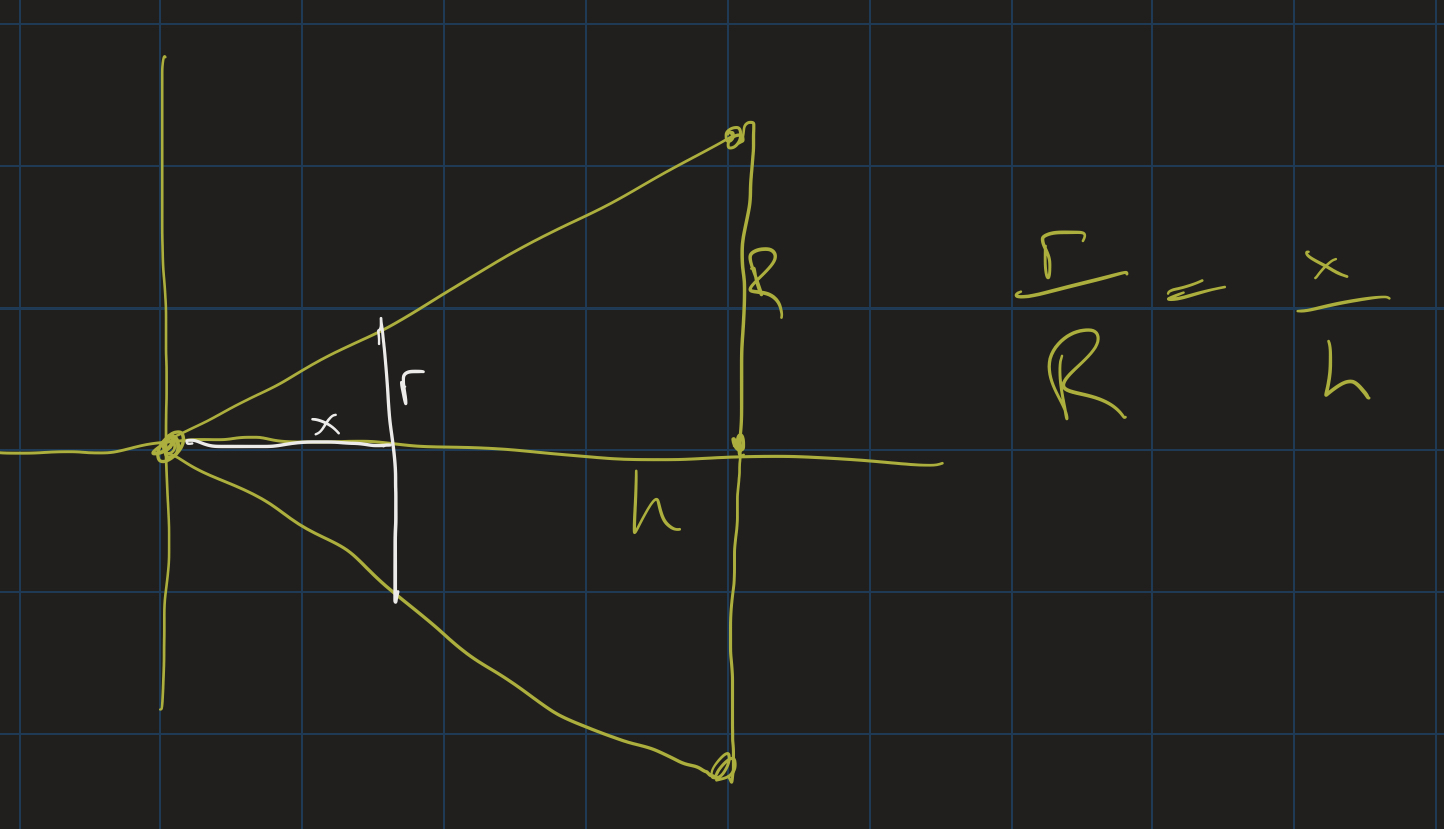
Solution: First we see that $r = \frac{Rx}{h}$, so the area of that slice is $\pi (\frac{Rx}{h})^2$. Set up the volume integral:
\[\begin{align} V &= \int_0^h \pi (\frac{Rx}{h})^2 dx \\ &= \pi \frac{R^2}{h^2} \int_0^h x^2 dx \\ &= \left. \pi \frac{R^2}{h^2} \frac{x^3}{3} \right|_0^3 \\ &= \pi \frac{R^2}{h^2} \frac{h^3}{3} \\ &= \frac{1}{3} \pi R^2 h \end{align}\]Revolution
Other three dimensional figures can be found by revolving 2D regions around axes.
Notice
When we revolve an entire region bounded by a curve $y = f(x)$ around the $x$-axis:
- Cross sections are circle: $A(x) = \pi r^2$.
- $r = f(x)$: the radius of each circle is $f(x)$!
- $V = \int_a^b \pi (f(x))^2 dx$
Example
Find the volume of the solid formed by revolving the region bounded above by $y = x^2$, below by the $x$-axis, between $x = 0$ and $x = 2$, around the $x$-axis.
Solution
\[\begin{align*} V &= \int_0^2 \pi (x^2)^2 dx \\ &= \pi \int_0^2 x^4 dx \\ &= \pi \left.\frac{x^5}{5} \right|_0^2 \\ &= \frac{32\pi}{5} \approx 20.1 \end{align*}\]Exercise
- Find the volume of the solid formed by revolving the region bounded by $f(x) = 1 - x^2$, $x = 0$, $x = 1$, and the $x$-axis around the $x$-axis.
- Find the volume of solid formed by revolving the region bounded on the left by $x = 1$, and above by $y = \frac{1}{x}$, around the $x$-axis.
Try to sketch the 3D solids that are formed in each case.
Gabriel’s Horn
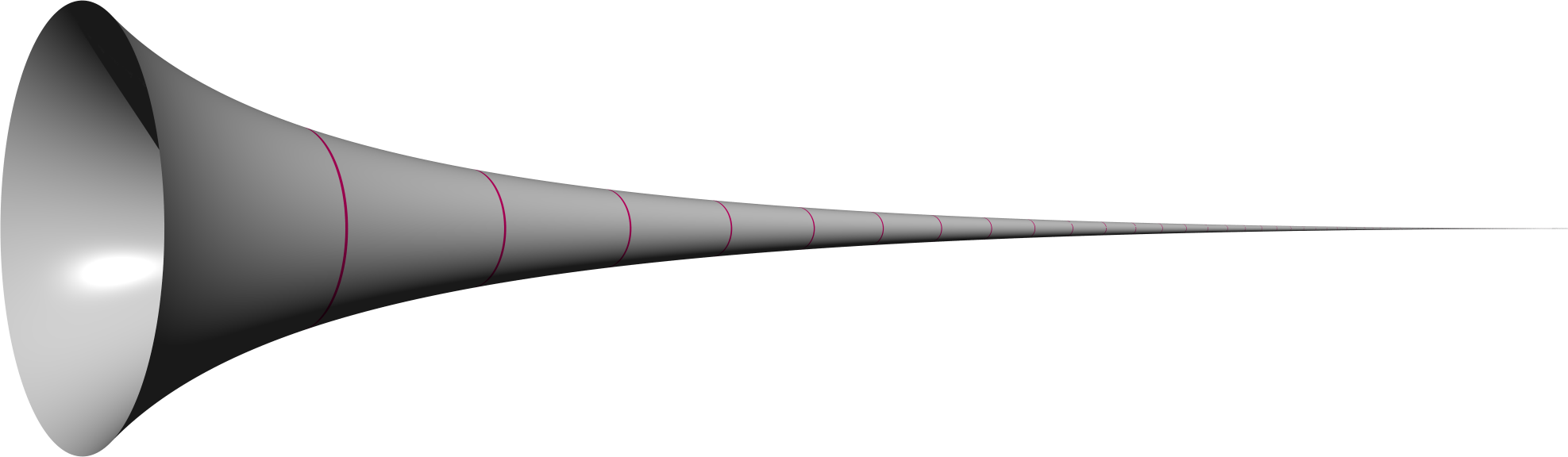
- “Gabriel’s Horn” (Who is Gabriel?)
- Finite Volume
- Infinite length?
- 2D Projection: infinite area
- Infinite surface area
Washer Method
What if we revolve a region bounded between two curves around the $x$-axis?
Cross Sections
- Cross sections are washers, outer radius $R$, inner radius $r$
- Area of a washer: $\pi (R^2 - r^2)$
- $R = f(x)$, $r = g(x)$.
- $V = \int_a^b \pi [(f(x))^2 - (g(x))^2] dx$
Example
Find the volume of the solid formed by revolving the region bounded by $y = \sin(x)$ and $y = \cos(x)$ from $x = 0$ to $x = \frac{\pi}{4}$ around the $x$-axis.
Solution
\[\begin{align} V &= \int_0^{\pi/4} \pi (\cos^2(x) - \sin^2(x)) dx \\ &= \pi \int_0^{\pi/4} \cos(2x) dx \\ &= \left. \pi \frac{\sin(2x)}{2} \right|_0^{\pi/4} \\ &= \pi \cdot \frac{\sin(\pi/2)}{2} = \frac{\pi}{2} \end{align}\]Shells
 \
\
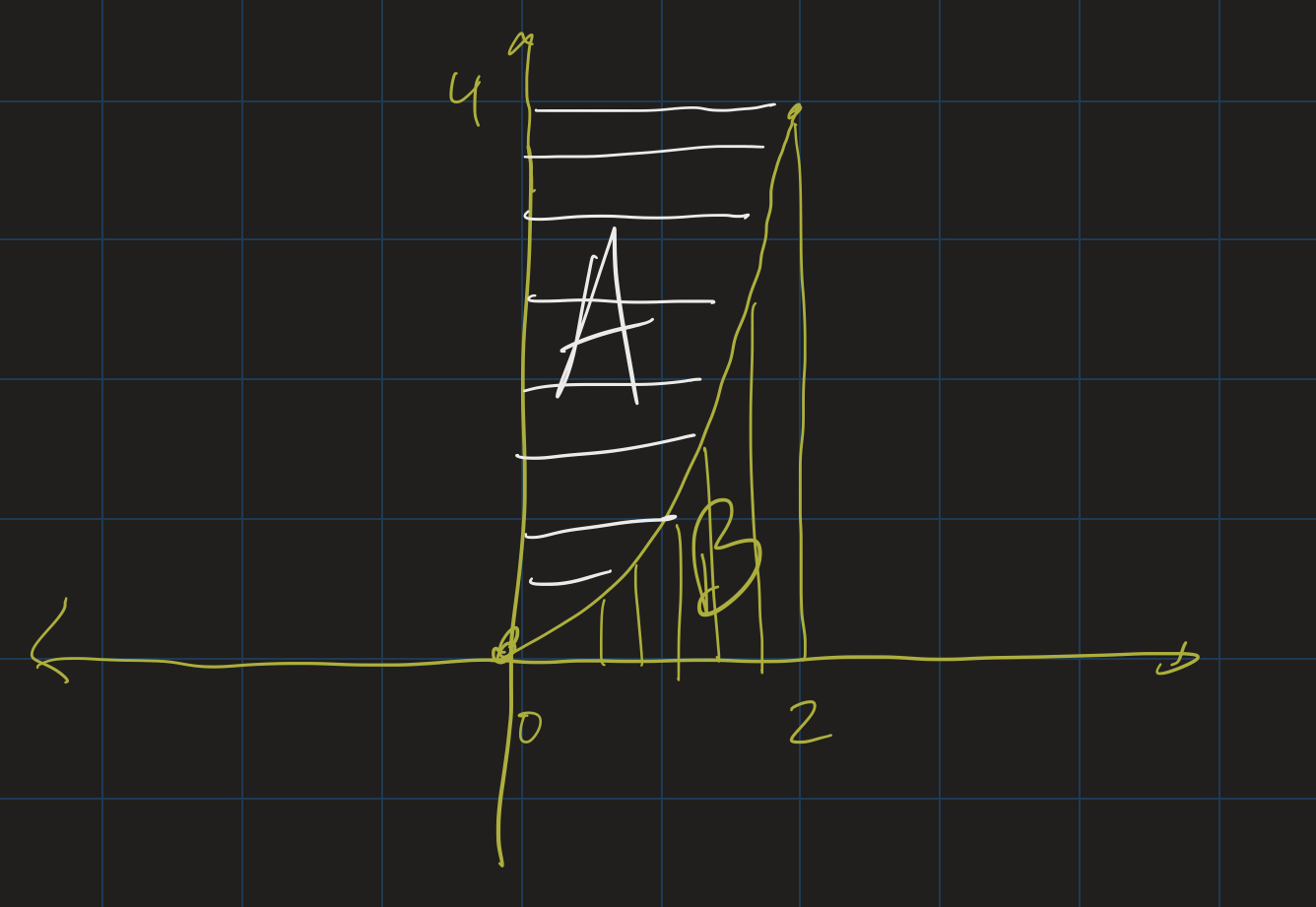
- Revolving regions around the y-axis?
- Which region?
- A: disk method. Convert to an integral using $y$ and $dy$
- B? Something else.
Shell Method
- Volume of one shell: $2\pi rh\Delta x$ (Why?)
- $r \approx x$
- $h \approx f(x)$.
- $V = \int_a^b 2 \pi x f(x) dx$
Upcoming
- MyOpenMath homework will be posted and due next Friday.
- Presentations continuing next week.