Calculus II Lesson 10: Volumes (Disk, Washer, and Shell Methods)
Presentations
We will start with our problem presentations.
Solids of Revolution: Disk method
Other three dimensional figures can be found by revolving 2D regions around axes.
Notice
When we revolve an entire region bounded by a curve $y = f(x)$ around the $x$-axis:
- Cross sections are disks: $A(x) = \pi r^2$.
- $r = f(x)$: the radius of each disk is $f(x)$!
- $V = \int_a^b \pi (f(x))^2 dx$
Example
Find the volume of the solid formed by revolving the region bounded above by $y = x^2$, below by the $x$-axis, between $x = 0$ and $x = 2$, around the $x$-axis.
Solution
\[\begin{align*} V &= \int_0^2 \pi (x^2)^2 dx \\ &= \pi \int_0^2 x^4 dx \\ &= \pi \left.\frac{x^5}{5} \right|_0^2 \\ &= \frac{32\pi}{5} \approx 20.1 \end{align*}\]Exercise
- Find the volume of the solid formed by revolving the region bounded by $f(x) = 1 - x^2$, $x = 0$, $x = 1$, and the $x$-axis around the $x$-axis.
- Find the volume of solid formed by revolving the region bounded on the left by $x = 1$, and above by $y = \frac{1}{x}$, around the $x$-axis. (This region goes off to $\infty$ on the right.)
Try to sketch the 3D solids that are formed in each case.
Gabriel’s Horn
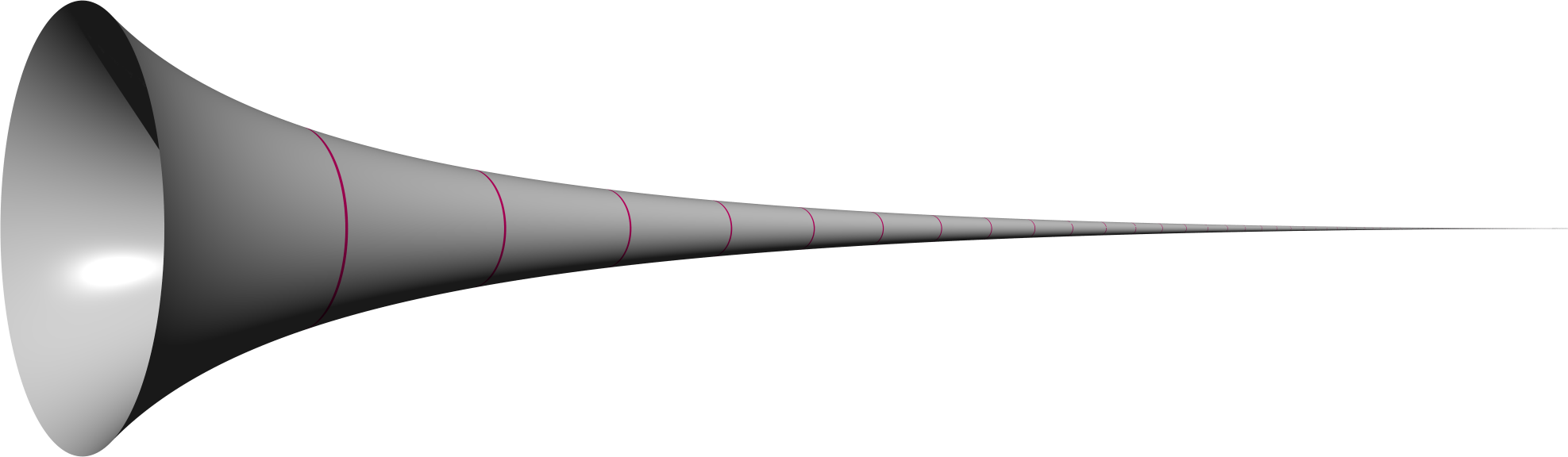
- “Gabriel’s Horn” (Who is Gabriel?)
- Finite Volume
- Infinite length?
- 2D Projection: infinite area
- Infinite surface area
Washer Method
What if we revolve a region bounded between two curves around the $x$-axis?
Cross Sections
- Cross sections are washers, outer radius $R$, inner radius $r$
- Area of a washer: $\pi (R^2 - r^2)$
- $R = f(x)$, $r = g(x)$.
- $V = \int_a^b \pi [(f(x))^2 - (g(x))^2] dx$
Example
Find the volume of the solid formed by revolving the region bounded by $y = \sin(x)$ and $y = \cos(x)$ from $x = 0$ to $x = \frac{\pi}{4}$ around the $x$-axis.
Solution
\[\begin{align} V &= \int_0^{\pi/4} \pi (\cos^2(x) - \sin^2(x)) dx \\ &= \pi \int_0^{\pi/4} \cos(2x) dx \\ &= \left. \pi \frac{\sin(2x)}{2} \right|_0^{\pi/4} \\ &= \pi \cdot \frac{\sin(\pi/2)}{2} = \frac{\pi}{2} \end{align}\]Solids of Revolution: Shell Method
Below is an animation of the “cylindrical shell” method: notice that when we revolve a region around the $y$-axis, each tiny vertical “strip” of the region revolves into a thin outer shell of a cylinder. This is why this method is called the “cylindrical shell” method.
Formula
In the above video, I go through and derive the formula for finding the volume of a region using the cylindrical shell method. Rather than copy that over here, I will point you to Section 2.3 of the textbook which has some nice illustrations as it goes through the steps of finding that formula.
The formula is as follows. Suppose we have a region bounded above by the graph of $y = f(x)$, below by the $x$-axis, to the left by $x = a$, and to the right by $x = b$. If we revolve this region around the $y$-axis, the volume of the solid formed is given by $V = \int_a^b 2\pi x f(x) dx$
Example
In the above video, I go through the example of finding the volume of the solid formed by revolving the region bounded above by $y = x^2$, below by the $x$-axis, to the left by $x = 0$ and to the right by $x = 1$ around the $y$-axis. First, set up the integral:
\[V = \int_0^1 2\pi x(x^2) dx\]We can pull out $2\pi$, and combine $x$ and $x^2$ to $x^3$, and get:
\[V = 2\pi \int_0^1 x^3 dx\]Integrating:
\[V = 2\pi \left. \frac{x^4}{4} \right|_0^1\]Plugging in the endpoints, our volume is $2\pi (\frac{1}{4}) - 2\pi (\frac{0}{4})$, or just $\frac{\pi}{2}$.
In this example, we find the volume of the solid formed by revolving the region bounded above by $y = \sqrt{1 - x^2}$, below by the $x$-axis, to the left by $x = 0$ and to the right by $x = 1$ around the $y$-axis. Again, first set up the integral:
\[V = \int_0^1 2\pi x \frac{1 - x^2} dx\]Here we can use a $u$-substitution. Let $u = 1 - x^2$, and $du = -2x dx$, or $-du = 2x dx$. Then since, when $x = 0$, $u = 1$, and when $x = 1$, $u = 0$, we get the following integral:
\[V = -\int_1^0 \pi \sqrt{u} du\]We can remove the negative sign by switching the order of the bounds:
\[V = \int_0^1 \pi \sqrt{u} du\]Now integrate by using the power rule:
\[V = \pi \left.(\frac{2}{3} u^{3/2}) \right|_0^1\]Plugging in the endpoint, the volume is $\frac{2\pi}{3}$.
Exercises
To practice, take a look at Section 2.3 problems 114-119.
Revolving around other lines
What happens if we revolve a region around a line that’s not the $x$ or $y$-axis? For example, what if we revolve the region bounded above by $y = x^2$, below by the $x$-axis, to the left by $x = 0$ and to the right by $x = 1$ around the line $x = -1$?
If we take any vertical slice of this region, revolving it around the line $x = -1$ will still give us a cylindrical shell, so our volume should still be $V = \int_a^b 2\pi r h dx$. In this case, however, the radius is given by $x + 1$, since the distance from a point $x$ and the line $x = -1$ is $x + 1$.
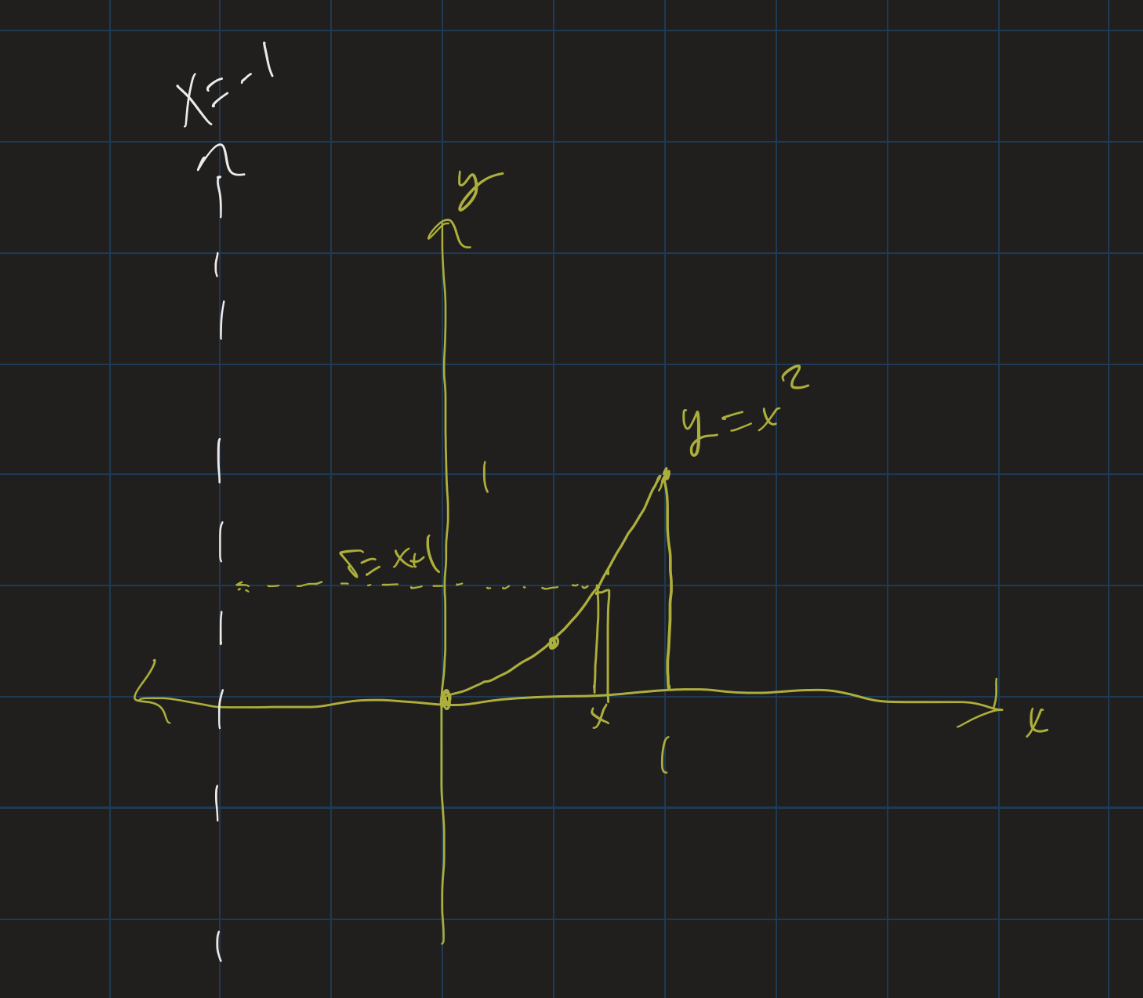
So we set up the integral:
\[V = \int_0^1 2\pi (x+1) x^2 dx\]We can pull out the $2\pi$ and distribute:
\[V = 2\pi \int_0^1 (x^3 + x^2) dx\]Now integrate:
\[V = 2\pi \left.(\frac{x^4}{4} + \frac{x^3}{3})\right|_0^1\]Plugging in the endpoints, the volume of this region is $2\pi (\frac{7}{12})$, or $\frac{7\pi}{6}$.
Exercise: (Hand in): Section 2.3 #145