Calculus II Lesson 11: Arc Length / Differential Equations Intro
Upcoming
- Today:
- wrap up volumes and arc length
- Differential equations intro
- Monday: HW (MyOpenMath)
- Next Friday: Presentation 2 (VoiceThread)
- Next week: quiz
- Exam 2: 2 weeks (March 16)
- Bring a graphing calculator!
Volumes
- Disk method
- Washer method
- Shell method
More complicated regions:
- Can convert from $y = f(x)$ to $x = g(y)$
- Then use disk / shell / washer?
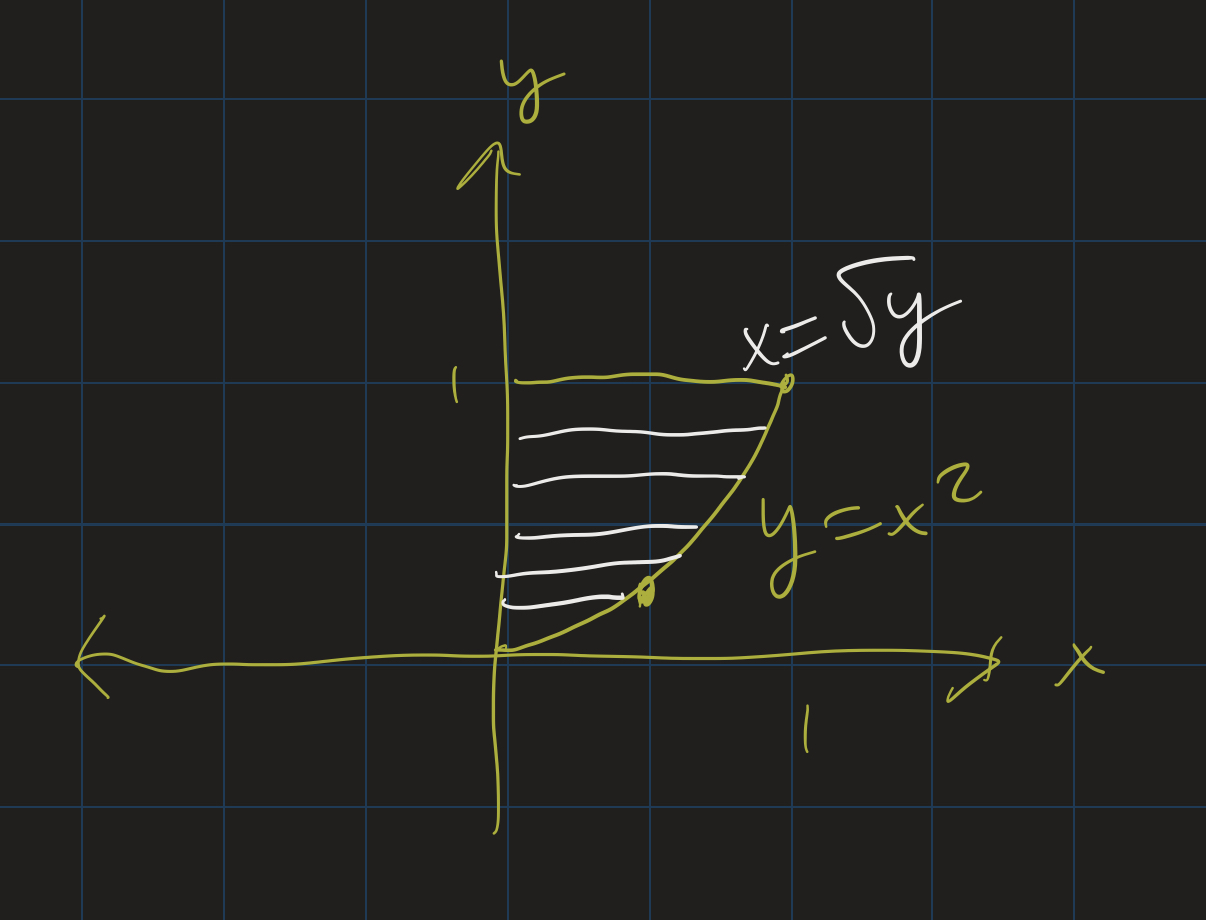
So we have actually 6 possible formulas:
- $V = \int_a^b \pi (f(x)^2) dx$.
- $V = \int_a^b \pi (g(y)^2) dy$.
- $V = \int_a^b 2\pi x f(x) dx$.
- $V = \int_a^b \pi (f(x)^2 - g(x)^2) dx$.
- $V = \int_a^b \pi (g(y)^2 - h(y)^2) dy$.
- $V = \int_a^b 2\pi y g(y) dy$.
Activity
Consider the following problems:
- Revolve the region bounded by $y = x$, $y = x^2$, $x = 0$ and $x = 1$ around the $x$-axis.
- Revolve the region bounded by $y = x^2$, $x = 0$, $x = 2$ and $y = 4$ around the $y$-axis.
- Revolve the region bounded by $y = x^2$, $x = 0$, $x = 2$ and $y = 0$ around the $y$-axis.
In small groups: For each problem:
- Pick the method you will use for this problem.
- Pick the formula you will use for the problem.
- Solve one of the problems.
- Pick one student to present your problem on one of the boards.
Arc Length
Formula:
\[s = \int_a^b \sqrt{1 + (f^\prime)^2 } dx\]- These integrals are tricky.
- Know how to do the algebra to set it up
- Then use a calculator (graphing or online)
First: review the notes / examples from last time.
- In particular, check out the notes on catenary arches.
Example
The path of a rock thrown off a 100 meter cliff (approximately) follows the curve $f(t) = 100 - 5t^2$, from $t = 0$ to $t = \sqrt{20}$ seconds. Find the length of the path the rock travels from $t = 0$ to $t = \sqrt{20}$. Round your answer to the nearest hundredth of a meter.
Example
Arc length of $f(t) = 100 - 5t^2$ from $t = 0$ to $t = \sqrt{20}$. Round your answer to the nearest hundredth of a meter.
\[\begin{align} f^\prime(x) = -10x \\ (f^\prime(x))^2 = 100x^2 \\ \int_0^{\sqrt{20}} \sqrt{1 + 100x^2}dx \end{align}\]WolframAlpha: $\approx 100.25$ meters.
Questions?
Before we move on:
- Questions about volumes?
- Questions about arc length?
- Catenary arch example?
Differential Equations
- Scientific experiments: can be easier to observe changes to data
- Might not know the actual formula describing your data
- How a quantity changes may be related to the quantity itself
- Ex: the more money you have, the more it earns in interest / investment
Sometimes:
- Can be easier to find the relationship between the change and the quantity
- Set up a differential equation
Example
- Suppose we are growing a bacteria culture.
- The larger the culture, the bigger the growth of the culture at any given time.
- Let $m(t)$ be the mass of the culture at time $t$. (Can easily measure its mass.)
- We notice: at any given $t$ (in seconds?), the culture grows at a rate $.05m(t)$
- Idea: take lots of measurements, compare mass to previous mass. Look for a pattern.
- Initial mass: 2 grams. Mass in 10 minutes?
We have a differential equation:
\[m^\prime(t) = .05 m(t)\]What functions are proportional to their own derivatives? Exponential functions! Guess $m(t) = Ae^{kt}$, and use $m^\prime$ and $m(0)$ to find these constants $A$ and $k$.
Solution (if time)
\[\begin{align} m(t) &= Ae^{kt} \\ m^\prime(t) &= Ake^{kt} \\ &= .05 m(t) \\ &= .05 Ae^{kt} \\ k &= .05 \end{align}\]So we have:
- $m(t) = Ae^{.05t}$
- $m(0) = 2$
Find $A$?
\[\begin{align} Ae^{0} = 2 \\ A = 2 \end{align}\]Solution:
- $m(t) = 2e^{.05t}$
- $m(10) = 2e^{.5} \approx 3.3$ grams.
Overview
- Any equation involving the derivative of a quantity is known as a differential equation.
- Example: $y^\prime = x$.
- A function $y = f(x)$ satisfying that equation is called a solution to the differential equation.
- In general: differential equations do not have unique solutions:
- $y = \frac{x^2}{2}$ is a solution to $y^\prime = x$.
- $y = \frac{x^2}{2} + 1$ is another solution.
Solutions to differential equations
- We look for a general form for a solution:
- $y = \frac{x^2}{2} + C$.
- If we have an initial condition, we can find an exact solution.
- Suppose $y^\prime = x$ and $y(0) = -1$.
- Then $y = \frac{x^2}{2} + C$.
- $-1 = \frac{0^2}{2} + C$
- $C = -1$.
- So: $y = \frac{x^2}{2} - 1$.
Order
The order of a differential equation is the highest derivative that appears in the equation. Exercise: Identify the orders of the following:
- $y^\prime = y + x$
- $(y^\prime)^2 = (y - x)^2$
- $y^{\prime\prime} = -y$
- $y^{\prime\prime\prime} + (y^\prime)^5 = y$
We will mostly focus on first-order differential equations, but some simple higher order differential equations can be solved.
Example
A ball is thrown straight into the air with an initial velocity of 5 meters per second. It is acted on by a constant, downward force of gravity, causing an acceleration of $-9.8$ $m/s^2$.
- Find a formula $v(t)$ for the velocity at time $t$ seconds after the ball is thrown.
- How many seconds after the ball is thrown does it reach its maximum height?
- If the ball is thrown at a height of 2 meters above the ground, what is the maximum height reached?
Solution
Since $v^\prime(t) = a(t)$, and $a(t) = -9.8$, we know:
- $v^\prime(t) = -9.8$
- $v(0) = 5$.
So: $v(t) = -9.8t + C$. Since $v(0) = 5$, we can compute $5 = -9.8(0) + C$, so $C = 5$.
So our formula for the velocity is $v(t) = -9.8t + 5$. Going back to Calc I:
- the ball reaches its maximum height when its upward velocity is 0
- $v(t) = -9.8t + 5 = 0$
- Solve for $t$: $t = \frac{-5}{-9.8} \approx .51$ seconds.
- Derivative of height: velocity.
- $h^\prime(t) = -9.8t + 5$.
- So: $h(t) = -4.9t^2 + 5t + C$.
- $h(0) = 2$ means $-4.9(0) + 5(0) + C = 2$
- So $C = 2$
Therefore $h(t) = -4.9t^2 + 5t + 2$. Then $h(\frac{5}{9.8}) \approx 3.28$ meters. This is basically the exam 1 extra credit problem.
Wrap-up
- We really solved a second-order differential equation:
- $h^{\prime\prime}(t) = -9.8$
- Initial condition: $h(0) = 2$ and $h^\prime(0) = 5$.
- We did this by splitting it up into two steps:
- First find $h^\prime(t)$
- Then find $h(t)$.