Calculus I Lesson 8: Higher Order Derivatives
Warm Up
\[f(x) = \begin{cases}x^2 - 1 &\mbox{if } x < 1 \\ x - 1 &\mbox{if } x \geq 1 \end{cases}\]Is $f(x)$ differentiable, continuous, both, or neither at the following points:
- $x = 0$
- $x = 1$
- $x = 2$
x = 0
$x^2 - 1$ is differentiable at $x = 0$. Therefore it is also continuous.
Answer: Both
x = 1 Differentiable?
Need to check left and right hand limits of
\[\lim_{x \rightarrow 1} \frac{f(x) - f(1)}{x - 1}\]From the left: $\dfrac{(x^2 - 1) - 0}{x - 1} \rightarrow x + 1 \rightarrow 2$.
From the right: $\dfrac{x -1 - 0}{x - 1} \rightarrow 1$. Not differentiable
x = 1 Continuous?
Now we check if $f(x)$ is continuous at $x = 1$:
- $f(1) = 0$
- ${\displaystyle\lim_{x\rightarrow 1^-}} f(x) = {\displaystyle\lim_{x \rightarrow 1^-}} x^2 - 1 = 0$
- ${\displaystyle \lim_{x\rightarrow 1^+}} f(x) = {\displaystyle \lim_{x \rightarrow 1^+}} x - 1 = 0$.
So $f$ is continuous at $x = 1$.
x = 2
$x - 1$ is differentiable, its derivative is $1$ near $x = 2$. Differentiable functions are continuous, so both.
Graph
Higher Order Derivatives
Given a function $f$:
- $f^\prime$: first derivative of $f$ with respect to $x$
- represents “How fast $f$ is changing at each $x$”
- positive / negative / 0?
- $f^{\prime\prime}$?: second derivative
- How fast is $f^\prime$ changing?
- How fast is $f$ accelerating?
- $f^{\prime\prime\prime}$?
- $f^{(n)}$ ($n$-th derivative)?
Physics Example
- Ball thrown straight in the air. $t$ = seconds, $h$ = meters
- $h(t) = -5t^2 + 20t + 2$ meters, $t$ seconds after it is thrown
- What does $h^\prime(t)$ mean?
- What does $h^{\prime\prime}(t)$ mean?
Crime Example

This graph shows the US Violent Crime Rate over time.
- What does the derivative of this graph represent?
- What does the second derivative of this graph represent?
COVID-19
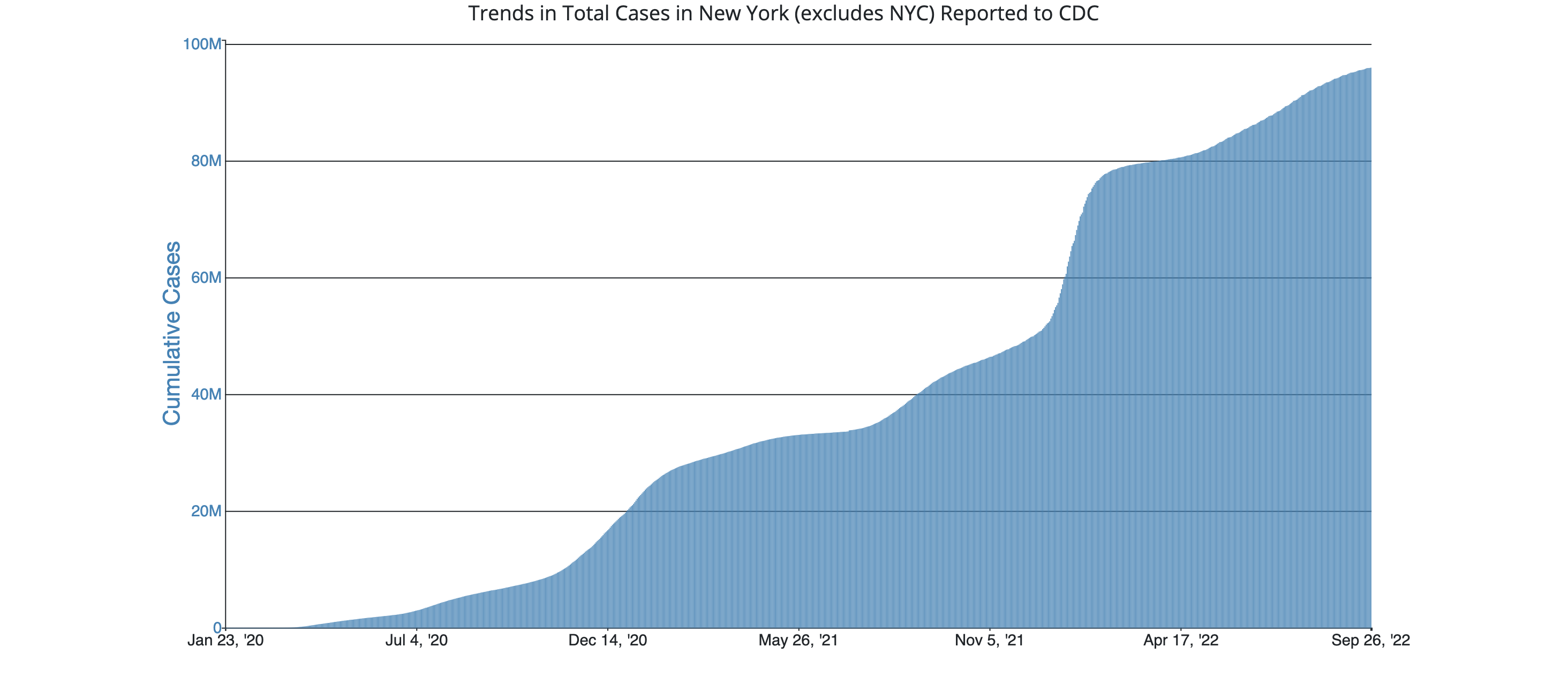
Take a look at the following graphs.
Graph 1: total COVID cases in NY (excluding NYC) over time:
Graph 2: daily COVID cases in NY (excluding NYC) over time:
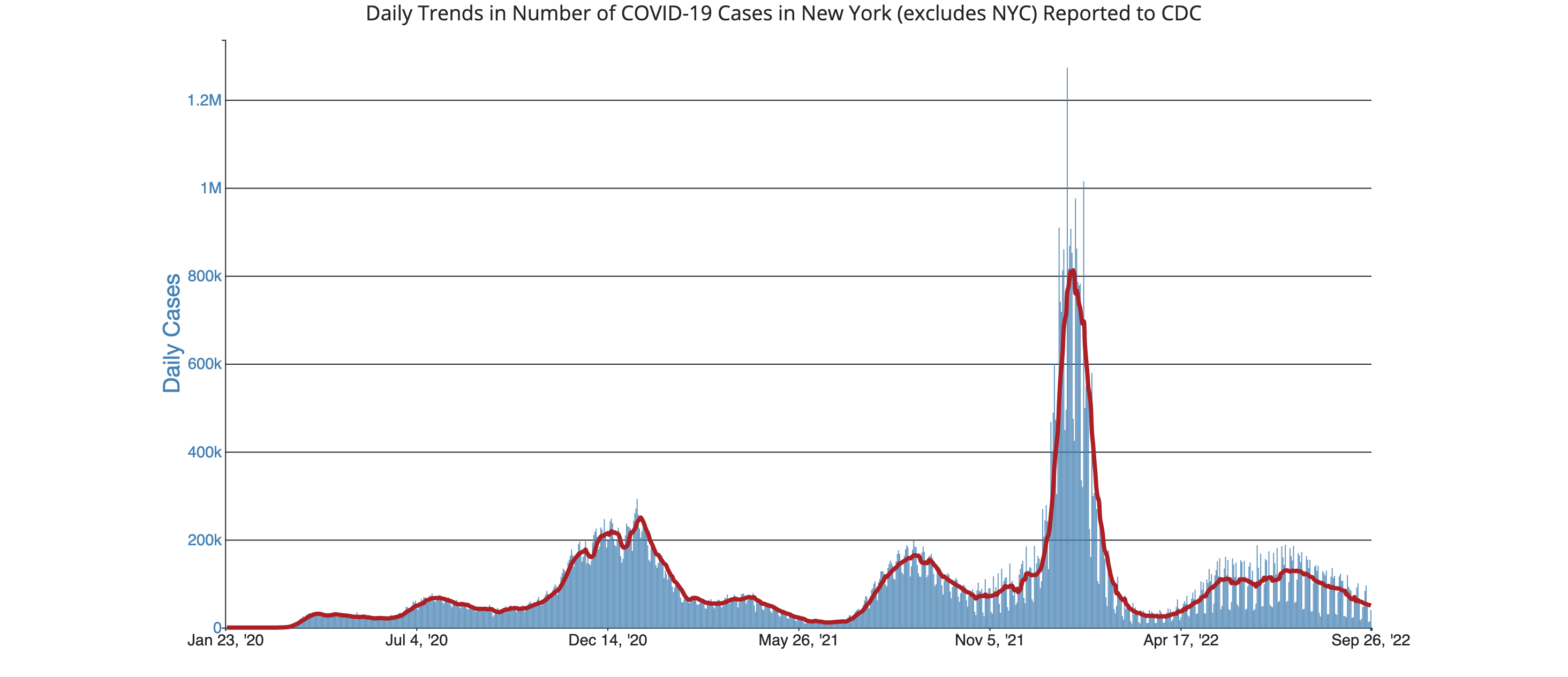
What does the derivative of each of these graphs represent? What stands out to you about these derivatives?
Tangent Lines
Recall that we defined the derivative to mean: “the slope of the tangent line”. How do we actually figure out what that tangent line is?
Problem: Find the equation of the line tangent to $y = x^3 - 2x$ at $x = 1$.
Recall: point-slope form: $y - y_0 = m(x - x_0)$
- Point: $(x_0, y_0)$ is $(x, f(x))$
- Slope: $m = f^\prime(x)$
So how do we find the equation? First find the point. Since we’re looking at $x = 1$, we plug in to find $y = 1^3 - 2(1) = -1$, so the point is $(1, -1)$.
Now let’s find the slope by taking the derivative. We want the slope at $x = 1$, so we look for $f^\prime(1)$. First find the derivative: $y^\prime = 3x^2 - 2$. At $x = 1$: $3(1)^2 - 2 = 1$.
So our equation is: $y + 1 = 1(x - 1)$, or $y + 1 = x - 1$. Or $y = x- 2$
Graph
Meaning of “Tangent Line”
What does the “tangent line” even mean? The idea is that it’s the best “linear approximation” of $f(x)$ at $x = a$. In other words: zoom in close to $x = a$ on the graph. The closer we get, the more accurate the tangent line appears.
Reminders
- DeltaMath HW 4 due tonight.
- DeltaMath HW 5 due Monday.
- Exam 1 Monday:
- One page of notes
- Graphing Calculator allowed
- Practice problems will be on BrightSpace tomorrow
- Some multiple choice, some short answer
- Sections 2.1 - 2.4, 3.1 - 3.4